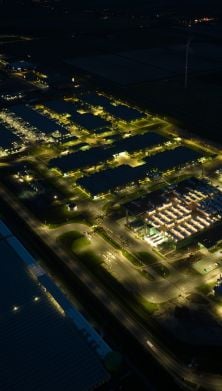
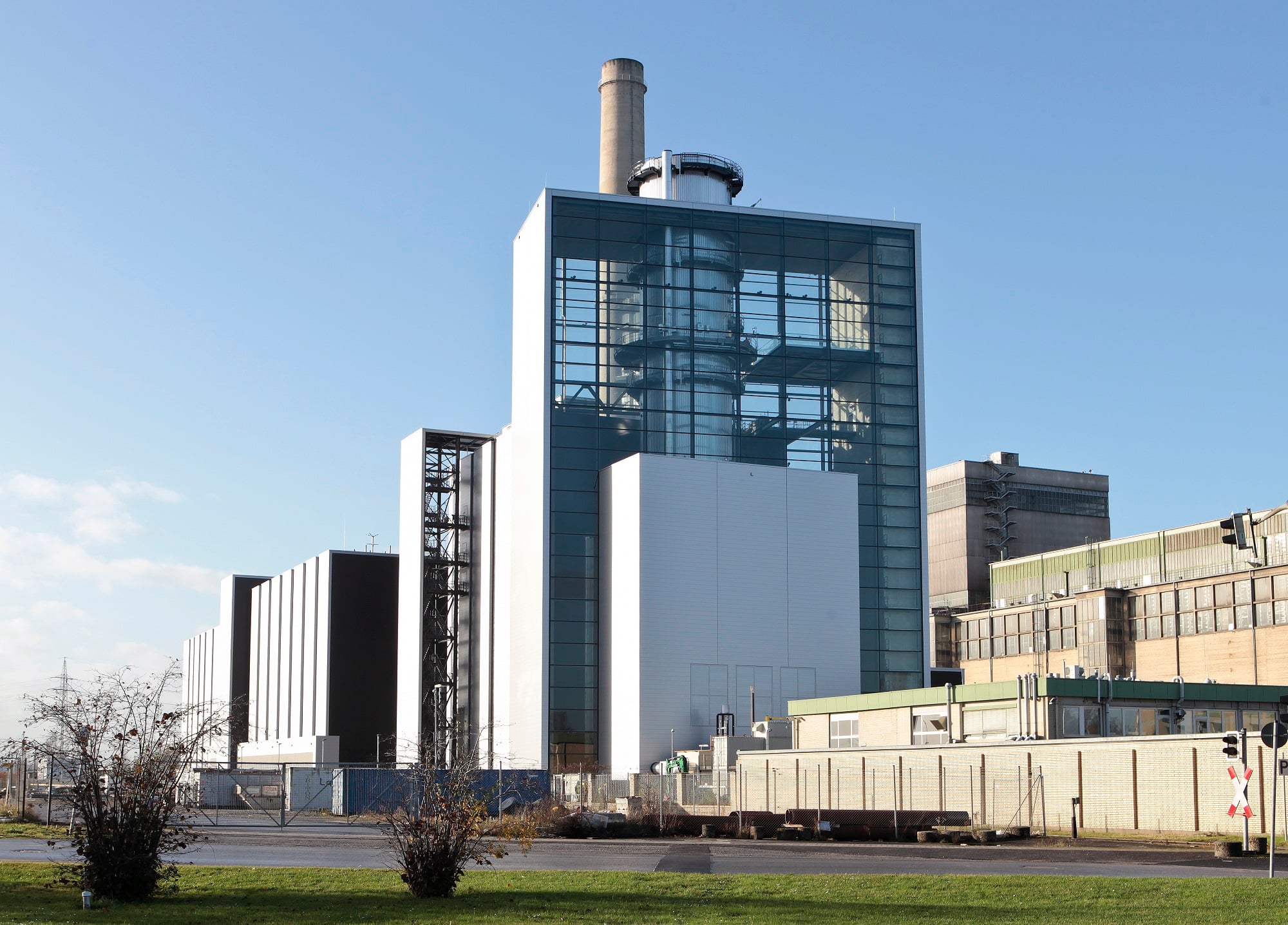
More powerful, more efficient, more environmentally-friendly and more flexible – Siemens has built the world’s most modern gas and steam power plant for the utility company Stadtwerke Düsseldorf in Germany.
Powered up
AGCS insured the $500m+ (€500m) construction of this innovative facility. In doing so, it has also contributed to the creation of a symbol for future-oriented electricity and heat generation.
SGT5-8000H – what sounds like the name of a Droid hero from the “Star Wars” series is actually the designation for a present-day masterwork from Siemens. More precisely, it involves a gas turbine that can perform true wonders as the key component in a gas- and steam-turbine power station. Siemens has built such a power plant for the utility company Stadtwerke Düsseldorf AG. Even before the official delivery – which arrived ahead of schedule – it was certain that the facility would immediately set several new world records.
Experts see the highly optimized machinery as key to the energy revolution. Nevertheless, the “Fortuna” gas- and steam-turbine power station at the Lausward location in Düsseldorf’s harbor area may remain the only one of its kind in Germany for now. But first things first.
The purely technical features of the brand-new power station are impressive: more than 600 megawatts (MW) of power-generating capacity through just one unit – a world record. Electrical efficiency of more than 61% – another world record. And finally, the third coup – “Fortuna” can deliver up to around 300 MW for the district heating system of Düsseldorf. In combination with the other records, this mark is also globally unprecedented. And it is decisive for the environmental goals of the city on the banks of the Rhine. “The energy revolution in big cities also means a heating revolution,” says Udo Brockmeier, CEO of Stadtwerke Düsseldorf. The city aims to be climate-neutral by 2050. Thanks to the heat-extraction process, fuel utilization is boosted to as much as 85%. “That reduces CO2 emissions by 600,000 tons in 2016 alone,” Brockmeier adds proudly.
Environmentally-friendly and flexible
He has a right to be proud because at the end of the year a hot-water storage unit will also be brought online, making the power station even more environmentally-friendly and flexible. The principle of the storage unit is simple: As soon as more heat is extracted from power generation than the city of Düsseldorf needs at that point in time, the storage unit absorbs the excess thermal energy. On the other hand, if there is a minimal need for electricity while there is a strong need for heating, this is covered by the storage unit without creating additional emissions.
Flexibility and efficiency. From the start, these two ideas preceded the development of the 450-ton 8000H gas turbine and its components. Willibald Fischer, Director of Gas Turbine Project Engineering at Siemens, recalls: “We started the 8000H program at the beginning of the 2000s. We had derived the following requirements from market developments beforehand: The worsening resource shortage of fossil fuels increases the need for efficiency of the components and the entire powerstation solution. In addition, our focus was on the topic of flexibility because power stations must also become much more flexible due to the significant growth of renewable energies.”
Wind and sun aren’t continuous energy sources. The seasonal and weather-related fluctuations can be offset by modern gas and steam power plants due to their short start-up times. They operate like a clock and harness the sometimes wild potential of renewables. At least theoretically. Because the prototype plant in Bavaria’s Irsching power station, where the 8000H turbine first went into operation after 10 years in development, was “only” a technological success. During a test run in May 2011, an electrical efficiency level of 60.75% was achieved – a sensation. But not sustainable. Commercially speaking, the poster child for future power generation in the post-atomic era quickly became a challenge for the plant operator E.ON. There are many reasons for that. All of them relate to the current paradigm shift in Germany.
On the one hand, renewable energies take priority in the grid supply. On the other hand, coal is now so cheap that gas-fired power plants cannot match the low electricity prices on the power exchanges. And then there is also emissions trading, which has failed to have an impact even years after its introduction. The CO2 certificates are simply too cheap. There are too many of them in the market. So it has turned out that coal-fired power plants are still running at full speed in the country that launched the energy revolution.
Flexibility and efficiency. From the start, these two ideas preceded the development of the 450-ton 8000H gas turbine and its components. Willibald Fischer, Director of Gas Turbine Project Engineering at Siemens, recalls: “We started the 8000H program at the beginning of the 2000s. We had derived the following requirements from market developments beforehand: The worsening resource shortage of fossil fuels increases the need for efficiency of the components and the entire powerstation solution. In addition, our focus was on the topic of flexibility because power stations must also become much more flexible due to the significant growth of renewable energies.”
Wind and sun aren’t continuous energy sources. The seasonal and weather-related fluctuations can be offset by modern gas and steam power plants due to their short start-up times. They operate like a clock and harness the sometimes wild potential of renewables. At least theoretically. Because the prototype plant in Bavaria’s Irsching power station, where the 8000H turbine first went into operation after 10 years in development, was “only” a technological success. During a test run in May 2011, an electrical efficiency level of 60.75% was achieved – a sensation. But not sustainable. Commercially speaking, the poster child for future power generation in the post-atomic era quickly became a challenge for the plant operator E.ON. There are many reasons for that. All of them relate to the current paradigm shift in Germany.
On the one hand, renewable energies take priority in the grid supply. On the other hand, coal is now so cheap that gas-fired power plants cannot match the low electricity prices on the power exchanges. And then there is also emissions trading, which has failed to have an impact even years after its introduction. The CO2 certificates are simply too cheap. There are too many of them in the market. So it has turned out that coal-fired power plants are still running at full speed in the country that launched the energy revolution.
Ideal framework
“Fortuna” seems to defy all these odds. That’s not just a lucky coincidence, as the name would suggest, but has a lot more to do with ideal framework conditions. The gas unit was constructed on the foundations of the former coal-fired power station. Therefore, the grid infrastructure already existed, as well as the proximity to the city. The power station’s central location is a perfect fit for cogeneration of heat and power. Heat production is the crucial distinction from the Irsching plant. Only heat production can make the facility really profitable.
On the technical side, the engineers have again gone the extra mile. “More precisely, it involves a combination of many detailed improvements to the whole turbine,” says Fischer. He was already the project manager responsible for testing prototype machines in Irsching, so he knew where to start. With regard to the compressor, it was about the flow dynamics of aspirated air. In the area of combustion, the challenge was to comply with emissions limits. A higher combustion temperature does indeed increase the efficiency, but unfortunately it also raises the levels of nitrogen oxide.
On the technical side, the engineers have again gone the extra mile. “More precisely, it involves a combination of many detailed improvements to the whole turbine,” says Fischer. He was already the project manager responsible for testing prototype machines in Irsching, so he knew where to start. With regard to the compressor, it was about the flow dynamics of aspirated air. In the area of combustion, the challenge was to comply with emissions limits. A higher combustion temperature does indeed increase the efficiency, but unfortunately it also raises the levels of nitrogen oxide.
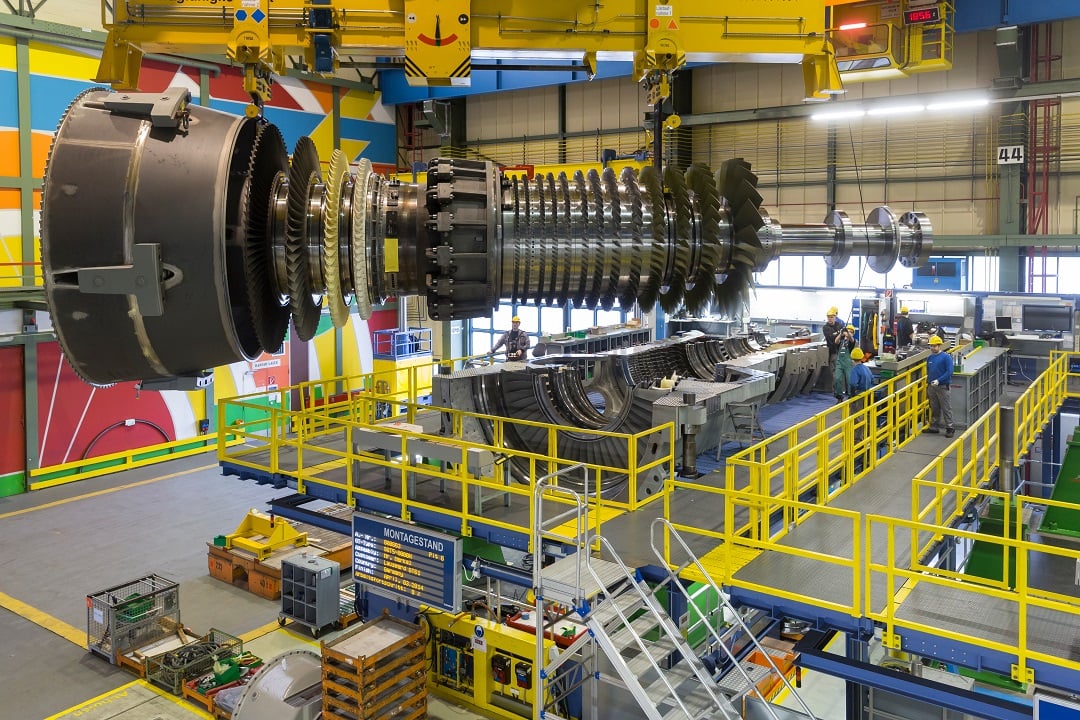
The turbine at the Siemens plant in Berlin
The turbine itself had to withstand the stress of temperatures in excess of 1,500 degrees Celsius. And finally, the host of developers also managed to significantly extend the downward range for partial-load operation to 35%. Converted for the Lausward location, this means a minimum of 200 MW without exceeding the CO2 emissions limit at the same time. That, too, was achieved by modifying the combustion system. Partial load is a bit like the core competency having a dialogue with the renewables. It allows the operators to curb their own production when wind- and solar-generated electricity floods the grids. Conversely, the power station can also get started again immediately.
Underwriting guides engineering
So how do you insure the construction of such a prototype facility? Through a profound technical understanding or, as Robert Maurer puts it, with the help of the following maxim: “underwriting guides engineering.” Maurer is head of engineering underwriting for Central and Eastern Europe at AGCS. “Whoever wants to insure prototype facilities – and we are leaders in this area – must make a considerable effort.”
“It is important that the producer involves the insurer in its planning at an early stage. Siemens does this incredibly well,” says Maurer, praising the collaboration. “It really is unusual how we are so closely involved,” confirms Gerhard Müller, Senior Risk Consultant at AGCS. Both Stadtwerke and Siemens provided Müller and his AGCS team with all the insights that they needed for their risk assessment. “At the beginning we naturally asked ourselves: 61% efficiency and various other records, how can that be – such a short time after Irsching?”
The duo of Maurer-Müller was already active with Allianz back then. This time, too, there was certainty at the end of the process in safely promising that the facility wouldn’t have to run constantly in the red range to achieve these results. In return for the trust and close cooperation, AGCS ultimately pledged full coverage. In total, the covered amount from construction insurance, erection insurance, project insurance and asset-damage insurance came to €470m. “Such coverage puts us in the Champions League,” Maurer says. It is all the more regrettable, he adds, that this type of gas and steam power plant simply doesn’t pay off at the moment because of the political situation. At least not in Germany.
“It is important that the producer involves the insurer in its planning at an early stage. Siemens does this incredibly well,” says Maurer, praising the collaboration. “It really is unusual how we are so closely involved,” confirms Gerhard Müller, Senior Risk Consultant at AGCS. Both Stadtwerke and Siemens provided Müller and his AGCS team with all the insights that they needed for their risk assessment. “At the beginning we naturally asked ourselves: 61% efficiency and various other records, how can that be – such a short time after Irsching?”
The duo of Maurer-Müller was already active with Allianz back then. This time, too, there was certainty at the end of the process in safely promising that the facility wouldn’t have to run constantly in the red range to achieve these results. In return for the trust and close cooperation, AGCS ultimately pledged full coverage. In total, the covered amount from construction insurance, erection insurance, project insurance and asset-damage insurance came to €470m. “Such coverage puts us in the Champions League,” Maurer says. It is all the more regrettable, he adds, that this type of gas and steam power plant simply doesn’t pay off at the moment because of the political situation. At least not in Germany.
Biggest individual order
Irsching provided a bombshell. While Siemens was still more or less on its own with the SGT5-8000H in 2011, a real race has emerged for the most efficient type of turbine since then. The toughest competitor is longtime rival General Electric (GE). However, more competition is emerging around the globe, for example, in Africa, China, Vietnam and the Middle East – generally where growing populations go hand in hand with economic development, which drives up power demand exorbitantly. Recently, Siemens clinched the largest individual order in its history with an €8bn contract. In Egypt, the industrial giant will construct, among other things, three gas and steam power plants, each with a capacity of 4.8 gigawatts and a total capacity of 14.4 gigawatts, over the next few years using the same turbine technology – 24 times greater than the installed capacity of the power station in Düsseldorf.
Future outlook
Perhaps in the not-too-distant future the tide will turn in favor of more modern gas-fired power stations in Germany as well. For example, when the last nuclear reactors leave the grid. Then other technologies will have to fill the gap. One means to harmonize the different energy sources and electricity generation plants even better in the future is called power-to-gas. In this system, excess energy from renewables is converted into hydrogen, using electrolysis, and saved. When needed, this could then be used directly in fuel cells to power cars or generators, for example. Or hydrogen can be used to create methane, also called synthetic natural gas, with the help of carbon dioxide. Fed into the natural-gas grid, it can ultimately fuel a gas and steam power plant. What’s special about the synthetic gas is that carbon dioxide is captured in production, in contrast to delivering fossil-fuel natural gas. That’s how a closed CO2 cycle comes about.
Until this cycle is complete, the power station in Düsseldorf remains, for now, a “symbol for futureoriented electricity and heat generation,” as Stadtwerke boss Brockmeier puts it. For this reason, and because “Fortuna” shapes the cityscape, his company has also attached a lot of importance to the facility’s exterior and has announced an architecture competition especially for this purpose. The facade’s futuristic design underscores the lighthouse effect. From the so-called city window at a height of 45 meters, visitors to the power station are offered “an impressive view of the North Rhine-Westphalian state capital and its surrounding areas,” Brockmeier says enthusiastically. With this type of transparency, Stadtwerke aims to increase its customers’ awareness of the city’s energy needs and where the energy actually comes from.
Until this cycle is complete, the power station in Düsseldorf remains, for now, a “symbol for futureoriented electricity and heat generation,” as Stadtwerke boss Brockmeier puts it. For this reason, and because “Fortuna” shapes the cityscape, his company has also attached a lot of importance to the facility’s exterior and has announced an architecture competition especially for this purpose. The facade’s futuristic design underscores the lighthouse effect. From the so-called city window at a height of 45 meters, visitors to the power station are offered “an impressive view of the North Rhine-Westphalian state capital and its surrounding areas,” Brockmeier says enthusiastically. With this type of transparency, Stadtwerke aims to increase its customers’ awareness of the city’s energy needs and where the energy actually comes from.
Fact & figures
How does a gas- and steam-turbine power station work?
With a gas turbine, filtered combustion air is fed into the compressor, then condensed at high pressure and burned, together with the delivered natural gas, in the combustion chamber. These combustion gases drive the turbine blades and set the “runner” in a rotating motion. This, in turn, powers the generator. Electricity is produced. The generated steam is extracted and channeled to as many as three heat condensers, in order to produce warm water for district heating.
What can 61.5% electrical efficiency do?
A gas and steam power station like this, with electrical efficiency of 61.5% and a total efficiency level of 85%, saves about 600,000 tons of CO2 in the first year of operation. This corresponds to the amount of CO2 emitted by 265,000 new medium-sized cars with an annual mileage of 15,000 kilometers. By 2025, the CO2 figure should even exceed 1 million tons.
600,000
Number of Düsseldorf residents who are supplied with heating and electricity from “Fortuna.”
1,340 MW
This much thermal energy can be saved in total. At the end of 2016, a hot-water storage unit will make the new natural-gas power station even more environmentally-friendly and flexible. With a height of 58 meters and a diameter of 30 meters, the district heating storage unit possesses enough volume for about 35,700 cubic meters of water. In total, up to 1,340 megawatt hours of thermal energy can be saved.
< 40 minutes
Within this time, the “Fortuna Powerhouse” can go from zero to running at a load of 100%.
With a gas turbine, filtered combustion air is fed into the compressor, then condensed at high pressure and burned, together with the delivered natural gas, in the combustion chamber. These combustion gases drive the turbine blades and set the “runner” in a rotating motion. This, in turn, powers the generator. Electricity is produced. The generated steam is extracted and channeled to as many as three heat condensers, in order to produce warm water for district heating.
What can 61.5% electrical efficiency do?
A gas and steam power station like this, with electrical efficiency of 61.5% and a total efficiency level of 85%, saves about 600,000 tons of CO2 in the first year of operation. This corresponds to the amount of CO2 emitted by 265,000 new medium-sized cars with an annual mileage of 15,000 kilometers. By 2025, the CO2 figure should even exceed 1 million tons.
600,000
Number of Düsseldorf residents who are supplied with heating and electricity from “Fortuna.”
1,340 MW
This much thermal energy can be saved in total. At the end of 2016, a hot-water storage unit will make the new natural-gas power station even more environmentally-friendly and flexible. With a height of 58 meters and a diameter of 30 meters, the district heating storage unit possesses enough volume for about 35,700 cubic meters of water. In total, up to 1,340 megawatt hours of thermal energy can be saved.
< 40 minutes
Within this time, the “Fortuna Powerhouse” can go from zero to running at a load of 100%.
Download the Global Risk Dialogue
Read this article in Global Risk Dialogue. Appearing twice a year, Global Risk Dialogue is the Allianz Global Corporate & Specialty magazine with news and expert insights from the world of corporate risk.
Sign up to the newsletter
Keep up to date on all news and insights from Allianz Commercial