
Article | June 2026

Atlantic hurricane season outlook 2026
The 2026 North Atlantic hurricane season runs from June 1 to November 30, with pre-season forecasts predicting near to below-average activity. Allianz Commercial’s catastrophe management team reviews the 2026 outlook, reflects on 2025, considers how climate change is impacting hurricane behavior, and highlights risk management preparedness for the season ahead.
The table below summarizes pre-season forecasts for 2026 published by AccuWeather, Colorado State University (CSU), National Atmospheric and Oceanic Administration (NOAA), North Carolina State University (NCSU), Tropical Storm Risk (TSR), and the UK Met Office. The 2026 season is expected to feature six to 16 named storms, three to nine hurricanes, and one to four major hurricanes. The most conservative of the forecasters, NOAA, puts the probability of a below-normal season at 55%.
The Cape Verde region of the central Atlantic, where approximately three-quarters of major hurricanes originate, is currently experiencing below-average sea surface temperatures (SSTs). Storms forming in this area typically have greater potential to intensify. In light of these cooler conditions and the anticipated El Niño phase, leading institutions forecast a below-average to average hurricane season.
Predictions by institution
Swipe to view more
|
Source
|
Forecast publish date
|
Tropical storms*
|
Hurricanes*
|
Major hurricanes*
|
US storm landfalls
|
US hurricane landfalls
|
Rating
|
|---|---|---|---|---|---|---|---|
| NOAA (long-term norm 1991 - 2020) | 14 | 7 | 3 | 3.3 | 1.5 | Long-term normal | |
| AccuWeather [1] | March 25 | 11-16 | 4-7 | 2-4 | 3-5 | --- | Near to below average |
| CSU [2] | April 9 | 13 | 6 | 2 | --- | --- | Below normal |
| NOAA [3] | May 21 | 8-14 | 3-6 | 1-3 | --- | --- | Below normal |
| NCSU [4] | April 22 | 12-15 | 6-9 | 2-3 | --- | --- | Close to average |
| TSR [5] | May 28 | 11 | 4 | 1 | 3 | 1 | Below normal |
| UK Met Office [6] | May 28 | 6-12 | 3-7 | 1-3 | --- | --- | Below average |
| 2026 forecast range | 6-16 | 3-9 | 1-4 | 3-5 | 1 | Near to below average | |
| Comparison: 2025 hurricane season forecast (average) | 16 | 8 | 4 | 5 | Average |
*Tropical storm: > 39mph (> 63km/h); Hurricane: > 74mph (> 119km/h); Major hurricane: Categories 3-5, > 111mph (> 178km/h).
What is the El Niño-Southern Oscillation (ENSO)?
ENSO is a natural fluctuation in the sea surface temperature (SST) and air pressure across the Pacific Ocean with widespread impacts on global weather. It influences North Atlantic hurricanes, with La Niña years increasing activity and El Niño years reducing it.
“However, factors like Atlantic cycles and SST can offset these effects. Most losses come from a few hurricanes hitting populated areas,” says Stefanie Feuerstein, Atmospheric Perils Lead, Cat Research and Development, at Allianz Re. “In 2024, during a neutral ENSO phase, global natural catastrophe losses reached around $368bn, with $145bn insured losses. Hurricanes Helene and Milton were significant loss drivers that year, with Helene resulting in the highest economic loss of approximately $75bn, while Milton accounted for the highest insured loss at around $20bn [7]. Many other major hurricanes, like Andrew and Katrina, were unrelated to ENSO. While 2026 forecasts predict a medium to low-activity hurricane season due to El Niño, similar forecasts in 2012 preceded Hurricane Sandy’s devastating impact on New York.”
Atlantic hurricane seasons by numbers
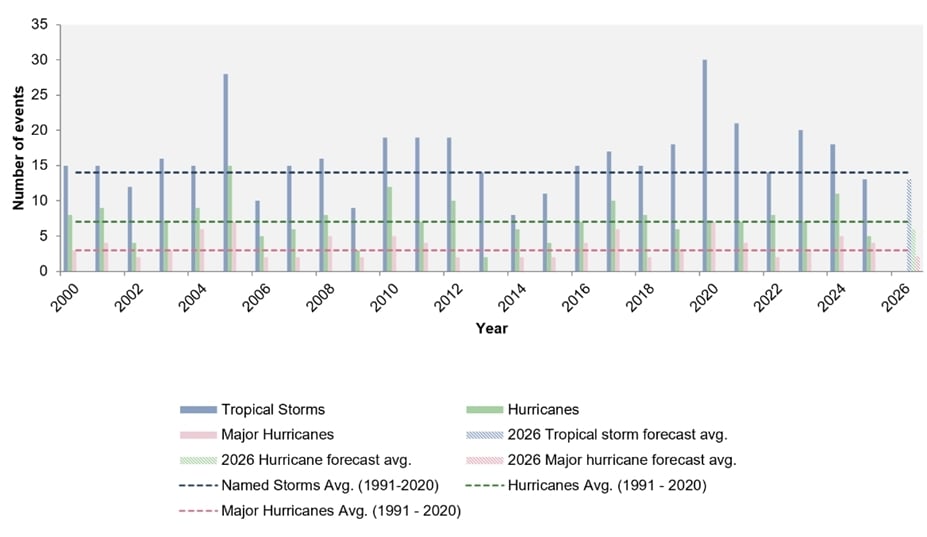
Atlantic hurricane season in numbers 2000 to 2025 and 2026 average forecasts: tropical storms, hurricanes, and major hurricanes. ‘Average’ hurricane season considers the period 1991-2020, according to the National Oceanic and Atmospheric Administration (NOAA).
Source data: National Hurricane Center/NOAA. Graphic: Allianz Commercial.
How does climate change affect hurricanes?
Climate change may influence the damage potential of hurricanes through shifts in their tracks, landfall locations, overall frequency, intensity, precipitation rates, and storm surge potential. The latter two factors are closely tied to flood risks: a warmer atmosphere holds more moisture, leading to increased precipitation, and rising sea levels amplify storm surge risks. [8] According to the latest research, a reduction in the overall frequency of North Atlantic hurricanes is projected with a 2°C warming resulting from human-caused climate change, while the proportion of major Category 4 or 5 storms could increase, resulting in fewer but potentially more severe US and Gulf of Mexico landfalls. [9]
Climate change is already altering how Atlantic tropical cyclones behave, making them faster to intensify and more extreme when they do. A 2023 study in Scientific Reports finds that mean maximum intensification rates* of Atlantic storms were approximately 29% higher in 2001-2020 than in 1971-1990. [10] The number of storms jumping from Category 1 or weaker to major hurricane status within 36 hours has more than doubled, consistent with human-caused climate warming.
Research also shows a poleward shift [11] in the latitude at which tropical cyclones reach peak intensity globally [12], raising exposure risk in regions not historically in the storm belt. This trend is less evident in the North Atlantic, although Subtropical Storm Karen’s formation in 2025 at the farthest-north genesis point on record in the NOAA’s National Hurricane Center database was a significant milestone.
For catastrophe models that rely on historical averages, these shifts represent an underestimation of tail risk (rare, high-impact events).
*Mean maximum intensification rate: the fastest 24-hour wind speed increase observed within each storm’s lifecycle, averaged across the storm population for a given period; Rapid intensification (RI): defined by NOAA’s National Hurricane Center as a wind speed increase of ≥35mph (30kt) in 24 hours.
Tropical cyclone losses in the US 2009-2025
Source: Insurance Information Institute
Graphic: Allianz Commercial
Graphic: Allianz Commercial
2025 hurricane season in a nutshell
The 2025 North Atlantic hurricane season produced one of the lowest years for US hurricane-related insured and economic losses in the past decade, largely because no hurricane made landfall in the continental US for the first time since 2015.
According to Aon’s 2026 Climate and Catastrophe Insight report, the global insured natural catastrophe losses reached approximately $127bn in 2025, marking the sixth consecutive year above $100bn. Economic losses from Hurricane Melissa across the Caribbean were estimated at approximately $11bn, while insured losses were estimated to be close to $2.5bn.
Between 2016 and 2024, the report notes that North Atlantic hurricanes generated average annual economic losses exceeding $75bn and insured losses above $30bn. In 2025, both metrics fell below $1bn for the US, representing the lowest US hurricane loss year since 2015. [13]
Despite the relatively benign US loss outcome, the season was notable for the intensity of the storms that did form. Pre-season forecasts anticipated 12-19 named storms, while 13 ultimately developed. However, four of the five Atlantic hurricanes intensified into Category 4 or 5 systems, representing one of the highest proportions of major hurricanes relative to total hurricanes observed in the Atlantic historical record. All four major hurricanes underwent rapid intensification, while seasonal accumulated cyclone energy (ACE) reached approximately 108% of the 1991-2020 long-term average despite below-average hurricane counts. [14]
The season reinforced an increasingly important catastrophe risk management consideration: lower storm frequency does not necessarily imply lower severity potential.
Standout events from the 2025 hurricane season [15]
📌 SEASON CLUSTERING - 2 concentrated activity windows: June 24 to July 6 produced Andrea, Barry and Chantal in 12 days, all weak tropical storms, none reaching Category 1. Then, after a 19-day period of zero activity at the peak of the season, late September featured overlapping storm lifecycles: Humberto reached its minimum central pressure of 924 hPa during a period when Gabrielle was still a Category 4 hurricane and Imelda had recently formed. The 19-day lull (August 29 to September 16), the first peak-season silence since 1992, coincided with persistent Saharan dust intrusions, dry mid-level air, and elevated vertical wind shear.
📌 CHANTAL – US LANDFALL ~$500mn from a 50 knots tropical storm: The only US landfall of 2025, Chantal never reached hurricane strength, but this tropical cyclone system incurred half a billion dollars of economic losses. Exposure density along the US coast means even a marginal system carries significant loss potential, independent of storm classification. [16]
📌 INTENSITY CONCENTRATION - 3 of 5 hurricanes were Category 5: 2025 saw the fewest total hurricanes since 2015 and yet the second highest number of Category 5s on record, trailing only 2005. A season can look quiet on storm counts and still carry extreme severity at the tail. Four of the five hurricanes reached Category 4 or above.
Beyond storm counts: risk management in 2026
Atlantic hurricane counts are a weak predictor of landfall and loss risk, as records show: 1992 produced just four hurricanes and still delivered catastrophic Hurricane Andrew; 2010 saw 12 hurricanes with zero US landfalls; and 1985 recorded six of seven hurricanes making US landfall in a near-average season [17]. In 2025, five hurricanes formed and none made US landfall, a combination last observed in 1978 and 2006, yet Hurricane Melissa, arriving late in the season, was confirmed by NOAA as one of the strongest Atlantic basin hurricane landfalls on record [18].
“What drives loss is not how many storms form, but the intensity of individual events and where they make landfall,” says Keerthy Mohandas, Catastrophe Risk Research Analyst at Allianz Commercial. “For businesses operating in hurricane-exposed regions, this translates to two distinct but connected considerations for 2026 – hazard severity and exposure.”
1 Hazard severity: Rapid intensification events are becoming more frequent [19] and compress the window between a manageable forecast and an emergency operational response from days to hours. For businesses with assets in hurricane-exposed regions, a storm can escalate from a manageable risk to a direct threat faster than continuity plans can be activated, making early preparedness essential. [20]
2 Exposure: Rising coastal asset values and construction inflation mean that insured values may no longer reflect true replacement cost without active revaluation, a gap that only becomes visible after a loss [21]. Melissa’s Caribbean landfall illustrates the consequence directly – $11bn in economic losses against $2.5bn insured [22] – which left businesses across the region absorbing losses their coverage was never sized to meet.
“Preparedness decisions for 2026 need to be anchored in a clear understanding of exposure concentration, asset vulnerability, and the realistic severity of events that can occur even in a below-average season,” says Mohandas. “History suggests a below-average forecast has rarely guaranteed a below-average loss year, and 2026 is unlikely to be the exception.”
Don’t wait for the forecast
“It only takes one storm event to change lives, disrupt business, and cost billions,” adds Kevin Sandelin, Senior ARC Team Leader, Property – South Zone, at Allianz Risk Consulting. “A slow or quiet hurricane season can still cause devastation if a single storm hits a major city, or just one storm travels slowly across land, bringing days of rain.”
Storm resilience and preparedness should be in place well ahead of a potential extreme weather event. “Ideally, organizations should have been preparing years in advance, no matter what the forecast,” says Sandelin. “By utilizing tools such as Allianz’s CAReS [Climate Adaptation and Resilience Services], companies can identify their exposure to natural catastrophe events today and into the future based on different climate scenarios. Once they’ve identified exposed locations, they can complete a self-driven vulnerability assessment, to dig deeper into those vulnerable areas and identify how and where to mitigate risk with strategic facility improvements.”
References
[1] AccuWeather, Atlantic hurricane season forecast 2026: 11-16 named storms predicted by AccuWeather, March 25, 2026
[2] Colorado State University, Extended range forecast of Atlantic seasonal hurricane activity and landfall strike probability for 2026, April 9, 2026
[3] NOAA, NOAA predicts below-normal 2026 Atlantic hurricane season, May 21, 2026
[4] NC State News, 2026 Hurricane Season Could See 12 to 15 Named Storms; 6 to 9 Hurricanes, April 22, 2026
[5] Tropical Storm Risk, Pre-Season Forecast Update for North Atlantic Hurricane Activity in 2026, May 28
[6] Met Office, North Atlantic tropical storm seasonal forecast 2026, May 28, 2026
[7] Aon, Climate and Catastrophe Insight 2025, January 21, 2025
[8] Nature Communications, Climate change exacerbates hurricane flood hazards along US Atlantic and Gulf Coasts in spatially varying patterns, August 22, 2019
[9] Bulletin of the American Meteorological Society, Tropical Cyclones and Climate Change Assessment, March 2020
[10] Scientific Reports, Observed increases in North Atlantic tropical cyclone peak intensification rates, October 19, 2023
[11] Nature, The poleward migration of the location of tropical cyclone maximum intensity, May 14, 2014
[12] AGU / Journal of Geophysical Research: Atmospheres, Interbasin analysis of the poleward expansion of tropical cyclone potential intensity, February 12, 2026
[13] Aon, Climate and Catastrophe Insight 2026, January 20, 2026
[14] Colorado State University, Summary of 2025 Atlantic tropical cyclone activity and verification of authors’ seasonal and two-week forecasts, November 20, 2025
[15] Colorado State University, Summary of 2025 Atlantic tropical cyclone activity and verification of authors’ seasonal and two-week forecasts, November 20, 2025
[16] Gallagher Re, Natural Catastrophe and Climate Report Q3 2025, October 15, 2025
[17] NOAA, NHC Data Archive
[18] NOAA, 2025 Atlantic hurricane season marked by striking contrasts, November 25, 2025
[19] Scientific Reports, Observed increases in North Atlantic tropical cyclone peak intensification rates, October 19, 2023
[20] NOAA, 2025 NHC Verification Report Preview Atlantic Basin, November 2025
[21] Munich Re, Climate change presses on: Devastating wildfires and intense thunderstorms exacerbate losses for insurers, January 13, 2026
[22] Aon, 2026 Climate and Catastrophe Insight 2026, January 20, 2026
With additional contributions from Allianz Re


All the latest news, reports and hot topics
















Sign up to the newsletter
Keep up to date on all news and insights from Allianz Commercial