
Article | July 2026

Infrastructure: overlooked risks in overhead power lines and telecoms
Poles and overland lines are woven into the landscape, carrying power and connectivity across entire continents. They are rarely thought about – until they fail, taking power, connectivity and sometimes a company’s reputation down with them.
- Overland lines are everywhere and easily ignored, but their failure can cut power, halt connectivity and trigger liability claims that run into the billions. The business interruption outweighs the value of the asset and businesses hit hardest are rarely the ones that own the infrastructure that failed them.
- Aging is the central exposure. Poles and lines built decades ago are still in service, and the decay that matters most – below the groundline, or inside the fittings – is usually invisible until the moment of failure.
- Severe weather, wildfire and deliberate sabotage are converging threats – and because these networks are dispersed and the data on them scattered across systems and owners, the risk is hard to see, locate and manage.
- Although businesses cannot maintain an asset they do not own, they should map how much they depend on it, decide what redundancy is worth its cost, and align the right internal teams before a line goes down rather than after.
In November 2021, a timber power pole in Australia split along the very holes that had been drilled to test it. The pole had been rated for another 50 years of service. The routine check intended to confirm its strength appears to have weakened it instead.
In February 2024, a decayed utility pole in the Texas Panhandle broke, dropping its power lines on to dry grass. The result was the Smokehouse Creek Fire, the largest wildfire in state history, burning more than a million acres and causing over a billion dollars in damage.
In South Africa, theft and vandalism targeting electricity pylons, transformers and substations cost the national utility more than 221 million rand ($12mn) in the 11 months to February 2025.
Three continents, three different ways to fail: a pole undermined by the test meant to prove it sound; a pole rotting; a network stripped for its metal. What they share is not a cause but a blind spot. Infrastructure does not have to be buried to be overlooked; sometimes it is overlooked precisely because it has always been there, in plain sight.
Oliver Lauxmann, Global Practice Group Leader, Chief Underwriting Office – Liability, at Allianz Commercial, has a name for this blind spot: silent exposure. “Poles are invisible until the moment they fail,” Lauxmann says. “But this is not niche exposure. These lines cross geographies, industries and ownership structures, so a single failure rarely stays local.”
Why poles and lines fail
A utility pole looks simple: a post in the ground, carrying electric or telecommunication wires overhead. The engineering behind it is not, says José Luis Pallarés, Senior Risk Consultant, Liability, at Allianz Commercial. Each pole, Pallarés explains, is designed around forces specific to its location – wind and ice loading, the spacing and sag of neighboring spans, and the soil conditions at the base. Change any factor, and a pole built to last decades can become vulnerable far sooner than expected.
Broadly, poles and lines fail in one of three ways: the material itself degrades; the loads acting on them shift or exceed what they were built for, or someone deliberately damages them. The first is the quietest – and often the most advanced before anyone notices.
Wood decay is one of the most persistent problems. Treated poles resist rot for years, but the chemical preservatives degrade over time, and moisture trapped at or below ground level promotes fungal decay. A pole can look sound above ground while the timber below the groundline rots away, quietly shedding the strength that keeps it standing.
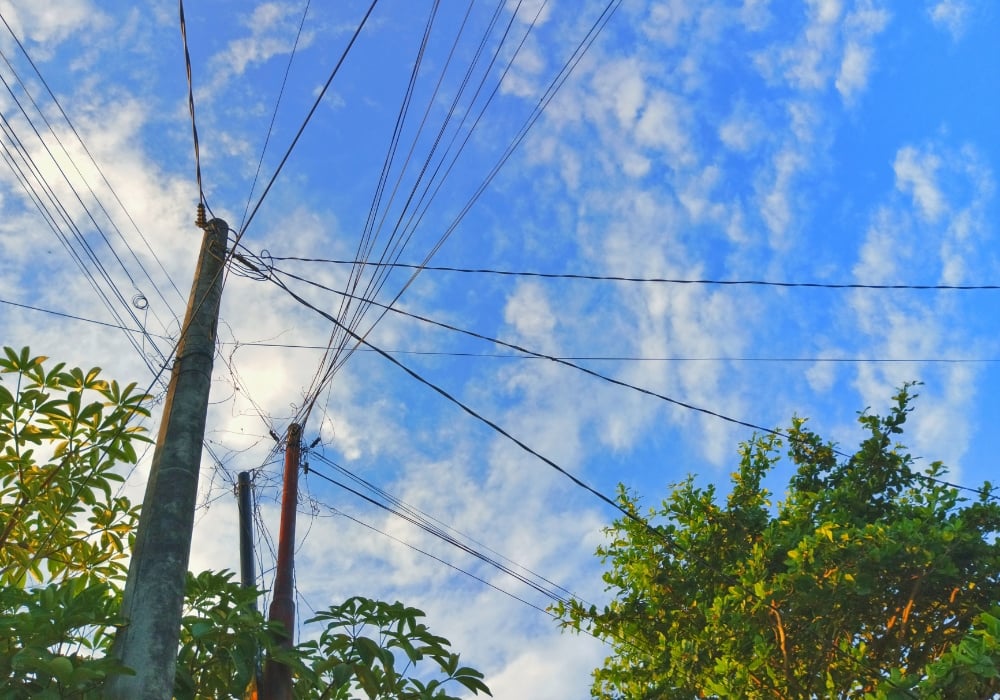
The second failure mode is often manmade. Where overhead pole-sharing is common – notably in parts of Asia Pacific, the UK and the US – utilities lease space to telecoms and cable tenants. Each new attachment adds weight, and every bolt, bracket and lag screw breaches the preservative treatment and exposes untreated wood, so water pooling around a fitting lets decay take hold.
How far this goes varies by region, but it is most extreme in parts of Latin America, where the largely unmonitored spread of cable providers has produced dense tangles of wiring (known locally as tallarines, or cobwebs), abandoned “ghost cables” no one removes.
The added weight leaves poles leaning and prone to collapse: Peru’s public-services ombudsman has flagged overloaded, tangled cabling and poles on the verge of falling in central Lima. A national clean-up has since stripped more than 200 tons of disused aerial cables from the country’s streets.
And the trend is toward more sharing: the EU’s Gigabit Infrastructure Act, applicable since 2025, now requires utilities to open their poles and towers to telecom operators.
Built for a different climate
But the heaviest loads a pole carries are not bolted on. They come from the weather – and the weather is changing.
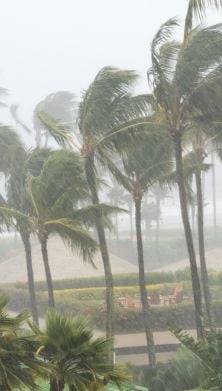
Pallarés is wary of reducing the problem to its most visible symptom: “Wildfire is the headline risk, but extreme weather is not one thing – it is many things arriving at once. The same infrastructure has to cope with heavier snow loads in winter, higher temperatures in summer, and with winds increasingly concentrated into short, violent episodes.”
The common thread is mismatch: “Infrastructure designed for the climate of 30 years ago is now being asked to perform in conditions it was never built for,” Pallarés says.
Aging assets, rising scrutiny
Overland lines are built to last: poles, conductors and lines can remain in service for decades. That endurance is a virtue until it quietly becomes a liability – every year of deferral compounding the question of how old is too old, how often to inspect, and when “still standing” stops meaning “still safe.”
The Texas case shows what happens when those questions go unanswered. The state later sued the utility, alleging negligent maintenance of its infrastructure, including nearly century-old poles. The 2023 Maui wildfires in Hawaii raised similar scrutiny of aging overhead power infrastructure.
“Aging infrastructure is a central part of the discussion,” says Lauxmann. “Utility companies need to ask whether assets are still fit for purpose, how they are maintained, and whether investment levels are sufficient to prevent avoidable failures.”
When the network fails, business stops
When a pole comes down or a line is cut, the first to feel it is the organization that owns the asset.
On June 20, 2024, a transmission tower near Glorit, Northland, in New Zealand, toppled after a contractor’s crew removed too many of the nuts securing at least two of its four legs. The maintenance meant to keep the tower standing brought it down instead.
For the grid operator, Transpower, the fallout was bruising: a regulator’s complaint (later dropped when an expert found it had met the required standards), criticism of an “entirely avoidable” failure and a NZ$1mn (over half a million US dollars) resilience fund (paid by Transpower and its lines maintenance operator Omexom).
But the operator’s own costs were dwarfed by the damage downstream. The collapse cut power to roughly 88,000 connections – about 180,000 residents and 20,000 businesses – for up to three days, at an estimated economic cost to the region of between NZ$37.5mn and NZ$80mn (US$21mn and US$45mn). Those businesses are now pursuing a class action to recover their losses. Not one of them owned the tower, maintained it or had any say in the crew that felled it.
Daphne Ricken, who works with industry practice groups including telecommunications within Allianz Commercial’s liability function, sees this second circle of exposure up close and is quick to point out that it is not confined to power utilities.
Key risks and challenges: poles and overhead lines
- Pole and conductor decay
- Aging infrastructure and underinvestment
- Overloading from shared attachments
- Storm, wind and ice loading
- Wildfire and bushfire exposure
- Cable and copper theft
- Sabotage and criminal damage
- Third-party damage and maintenance error
- Business interruption and failure to supply
- Liability and regulatory exposure
“Awareness is the first step,” says Ricken. “Clients need to understand where their exposures are, who owns or maintains the assets, and what alternatives exist if something goes wrong.
“For companies that depend on infrastructure such as power or telecommunications, the key question is simple: if the system fails, what is the backup plan?”
When the line is the target
Decay is indifferent, and weather is impersonal. The third way a line fails has intent behind it – and intent changes the risk, because an adversary picks the moment, the place, and the point of maximum damage.
Two motives dominate. The first is money: copper and steel are worth stealing – the kind of theft that has cost South Africa’s grid operator hundreds of millions of rand a year and takes the network down as collateral. The second is disruption, where the line is not loot but the target itself.
In March 2024, arsonists set fire to a high-voltage pylon near Grünheide, outside Berlin. The damage cut power to surrounding villages and brought Tesla’s Gigafactory to a standstill for more than a week; a left-wing extremist group claimed responsibility, declaring the aim of the “biggest possible blackout.”
For Lauxmann, the pattern matters as much as the individual incident. “Such sabotage examples show how attacks on grids or power stations can have implications for the wider network of lines and connected infrastructure.”
How can businesses mitigate the risks?
So, what can a business do? For companies that own and operate this infrastructure, preparation starts with knowing what they have. The asset register has no single address. That information is often scattered across departments, systems and, where ownership has changed hands, separate companies.
“The information we need to understand the risk is straightforward: where exactly is the asset, how old is it, what material it is, and when was it last inspected?” says Pallarés. “Often that data exists somewhere but is spread across different systems, different departments, sometimes different companies if the ownership has changed. You cannot manage a risk you cannot locate.”
For the companies that use and rely on the network, the risk management options might be more limited, but they do not include doing nothing. Although businesses cannot maintain an asset they do not own, they should map how much they depend on it, decide what redundancy is worth its cost, and align the right internal teams before a line goes down rather than after.
“When insurers ask for detailed information, there is a reason,” says Ricken. “Data on location, ownership, condition, maintenance and exposure is essential to understanding the risk.”
Overland lines: in numbers
1 million+ acres
burned in the Smokehouse Creek Fire, the largest wildfire in Texas history, traced to a single decayed utility pole
20,000 businesses
left without power when one transmission tower toppled during maintenance in Northland, New Zealand – now pursuing their losses through the courts
221 million rand
(about US$12mn) lost to theft and vandalism of grid infrastructure by South Africa’s national utility in 11 months
70%
of Australia’s 8.5 million wooden distribution poles are over 35 years old



All the latest news, reports and hot topics










Sign up to the newsletter
Keep up to date on all news and insights from Allianz Commercial