
Questions and answers | July 2026

Q&A - Overlooked risks in overhead power lines and telecoms
This Q&A provides answers to common questions about overhead power and telecoms risks, drawing on key insights and findings from Allianz Commercial's risk consulting experts.
What are some of the hidden risks in overhead power infrastructure?
Poles and overhead lines are woven into the landscape, carrying power and connectivity across entire continents. They are rarely thought about – until they fail, taking power, connectivity and sometimes even a company’s reputation down with them. Allianz Commercial risk experts call this blind spot “silent exposure” and it is not a niche one. These lines cross geographies, industries and ownership structures, so a single failure rarely stays local.
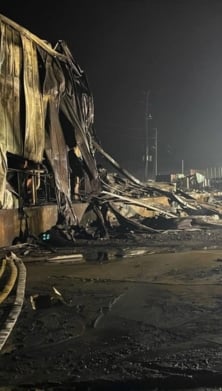
Some recent examples illustrate the global scope: In February 2024, a decayed utility pole in Texas sparked the Smokehouse Creek Fire – the largest wildfire in state history, burning over a million acres and causing more than a billion dollars in damage. In South Africa, theft and vandalism of grid infrastructure cost the national utility over $12mn in just 11 months. In Germany, arsonists targeting a single high-voltage pylon shut down Tesla’s Gigafactory for more than a week.
Why do utility poles and overhead lines fail?
Allianz Commercial risk consultants explain that poles fail in three main ways: material degradation, load changes, or deliberate damage.
Material decay is the failure mode most likely to go unnoticed. A pole can look sound above ground while timber below the groundline rots away. Treated poles resist decay for years, but preservatives degrade over time, and moisture at ground level promotes fungal rot – often undetected until collapse.
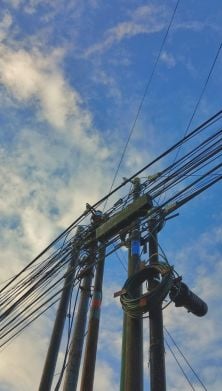
Overloading is usually manmade. Where pole-sharing is common – notably in parts of Asia Pacific, the UK and US – utilities lease space to telecoms tenants. Each attachment adds weight, and every bolt breaches the preservative treatment, letting decay take hold. In parts of Latin America, unmonitored cable sprawl has produced dense tangles of wiring, leaving poles leaning and prone to collapse. Peru’s public-services ombudsman has flagged overloaded poles on the verge of falling in central Lima.
Deliberate damage changes the risk entirely. As mentioned, copper theft has cost South Africa’s grid hundreds of millions of rand annually. Sabotage, meanwhile, targets maximum disruption – as the Berlin pylon attack demonstrated.
How is climate change compounding overhead infrastructure risks?
The weather is changing. Wildfire is the headline risk, but extreme weather is not one thing – it is many things arriving at once. The same infrastructure has to cope with heavier snow loads in winter, higher temperatures in summer, and winds increasingly concentrated into short, violent episodes.
The common thread is mismatch: infrastructure designed for the climate of 30 years ago is now performing in conditions it was never built for. In the US, the Texas and Maui wildfire cases have both raised scrutiny of aging overhead power infrastructure operating beyond its original design parameters.
According to Allianz Commercial liability experts, utility companies need to ask whether assets are still fit for purpose, review how they are maintained, and whether investment levels are sufficient to prevent avoidable failures.
What happens to businesses when infrastructure they don’t control fails?
When a pole comes down, the damage extends far beyond the asset owner.
In June 2024, a transmission tower in Northland, New Zealand, toppled after a contractor’s crew removed too many securing nuts during maintenance. The collapse cut power to about 180,000 residents and 20,000 businesses – for up to three days, at an estimated economic cost of between $21mn and $45mn. Many businesses are now pursuing a class action. Not one of them owned the tower or had a say in its maintenance.
Allianz Commercial risk consultants who work with telecommunications and other industry sectors see this exposure regularly. Companies need to understand where their exposures are, who owns or maintains the assets, and what alternatives exist if something goes wrong. For companies that depend on infrastructure such as power or telecommunications, the key question is simple: if the system fails, what is the backup plan?
What can businesses do to manage overhead line and pole risks?
For companies that own infrastructure, preparation starts with knowing what they have. Asset information is often scattered across departments, systems and – where ownership has changed – separate companies.
The information insurers need is straightforward: where exactly is the asset? how old is it? what material, and when was it last inspected? You cannot manage a risk you cannot locate.
For companies that rely on the network, options are more limited but not non-existent. Businesses should map their dependencies, decide what redundancy is worth its cost, and align internal teams before a line goes down – not after.
When insurers ask for detailed information, there is a reason. Data on location, ownership, condition, maintenance and exposure is essential to understanding the risk.
All the latest news, reports and hot topics










Sign up to the newsletter
Keep up to date on all news and insights from Allianz Commercial