
They might not pose an immediate threat to life on Earth, but intense geomagnetic storms could cause havoc with the technologies that modern life depends upon. With the current solar cycle expected to peak in 2025, Allianz risk experts discuss the potential impacts of a rare ‘space weather’ event.
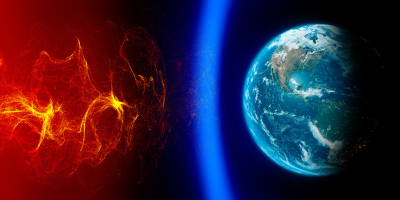
Here comes the Sun: the dangers of geomagnetic storms
Expert risk article | June 2024
The 1 minute dialogue
- Geomagnetic storms can occasionally cause massive damage to the high-voltage transformers that are crucial to electricity supply.
- The modern world‘s reliance on technology and energy means the exposures from such an event are significant and growing.
- Northern latitudes, particularly the US and Canada, are at particular risk.
- Preparing for a large geomagnetic storm should be integrated into a company‘s overall risk assessment and emergency response plans.
Stargazers and smartphone photographers witnessed a spectacular moment in time over two nights in May 2024. Social media and news outlets were dazzled by incandescent light plays from around the world – magenta skies gleamed over the city of Vienna, rainbow hues illuminated a lighthouse in England, emerald displays lit up the lakes of Minnesota, and violet lights danced over palm trees in Mexico’s Yucatan Peninsula.
In Europe, North America and China, onlookers were treated to a rare appearance by the Northern Lights in locations not usually visited by such displays, while the Southern Lights also staged a show in New Zealand.
The spectacles were triggered by a severe geomagnetic storm, the like of which Earth had not seen for over 20 years. Geomagnetic storms are induced when the Sun belches out tons of searingly hot plasma gas, or solar wind, from its atmosphere in a ‘coronal mass ejection’ (CME).

Photo: Ollie Taylor / ESA
Such was the severity of the May storm – designated a G5, the highest level – that the US scientific agency, the National Oceanic and Atmospheric Administration (NOAA), issued a rare warning about potential storm conditions.
Fortunately, despite some reports of disruption to high-frequency radio and GPS navigation systems, the storm did not significantly impact local populations. With an even stronger storm, however, the outcome could have been very different. A report from Bloomberg Intelligence (May 2024) warned that a major space storm could cost insurers even more than an event such as Hurricane Katrina ($55bn in 2005, or $90bn today), given its potential to disrupt radio communications, power grids, spacecraft, and satellite navigation. [1]
Our Sun switches between calm and active phases, alternating every 11 years. We are now in an active phase, expected to peak in 2025. While scientists say this is not a particularly active solar cycle, violent eruptions can occur at any time, and they can be devastating when they do.
Michael Bruch, Global Head of Advisory Services at Allianz Risk Consulting, explains the ionized plasma is typically deflected by Earth’s magnetic field to the North and South Poles, where the energized particles fall into the atmosphere. This causes the atmosphere to glow and creates beautiful auroras. However, geomagnetic storms can cause geomagnetically induced currents (GIC) in electric transmission grids, which can occasionally cause massive damage to the high-voltage transformers that are crucial to electricity supply.
The Carrington Event
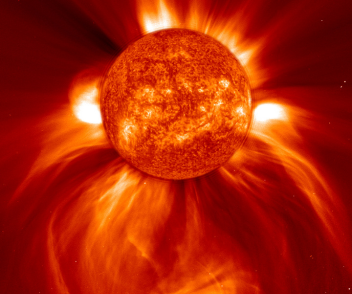
Photo: NASA/GSFC/SOHO/ESA
Bruch notes a solar storm in 1989 interrupted electricity supply to six million people for nine hours in the Canadian province of Quebec.
“That was when the temperature was minus 15 degrees Celsius,” Bruch adds. “The blackout wreaked havoc because it caused traffic guidance systems, airports, and district heating to shut down. The damage amounted to several million US dollars.”
CMEs are a difficult risk to plan for. Deniz Güney Akkor, Senior Risk Analyst of Global Underwriting Risk at Allianz Commercial, says the probability of a storm like the 1989 Quebec incident occurring somewhere in the world is around once every 70 years. Historical data suggests the probability of a storm exceeding a similar magnitude to the one seen in May 2024 will remain high in the next couple of years.
A typical CME can cross the 150mn kilometers between the Sun and Earth in one to five days. It can carry 10bn tons or more of hot magnetic plasma (charged particles) [2] into the solar system, and, if it hits Earth, causes a shockwave that violently compresses the magnetic field and transfers energy into the magnetosphere. A small geomagnetic storm may disrupt pigeon races, but stronger events can paralyze power grids, disrupt satellites, silence short-wave radio stations, and confuse GPS equipment.
The impact largely depends on the orientation and strength of the magnetic fields carried by the CME, as well as the conditions inside Earth’s magnetosphere, which can be dynamic, at the time of impact, says Akkor. A reference point for the potential impact of geomagnetic storms is the Carrington Event of 1859, Akkor explains.
That year, a large CME hit Earth’s magnetosphere and caused disruptions to telegraphs – the cutting-edge technology of the time – across Europe and North America. During the storm, excess currents were produced on telegraph lines, shocking technicians and sometimes setting equipment on fire. The auroras produced were so bright it is claimed people as far south as Cuba and Hawaii could read newspapers at night by their light.
Space weather events in a nutshell
The Sun is the main source of space weather. Eruptions of plasma and magnetic field structures from the Sun’s atmosphere, called coronal mass ejections (CMEs), and sudden bursts of radiation, called solar flares, can cause space weather effects at or near Earth. However, Earth’s magnetosphere, ionosphere, and atmosphere protect us from the most hazardous effects.
If a CME arrives at Earth, it can produce a geomagnetic storm, which can cause disruption to modern technologies, including widespread blackouts in extreme cases. Power outages due to space weather are rare, but evidence suggests significant impacts could occur, with cascading effects causing loss of:
- Water and wastewater distribution systems
- Perishable foods and medications
- Heating/air conditioning and electrical lighting systems
- Computer systems, telephone systems, and communications systems (including disruptions in airline flights, satellite networks and GPS services)
- Public transportation systems
- Fuel distribution systems and fuel pipelines
- All electrical systems that do not have backup power.
Source: Space Weather and Safety, National Weather Service, NOAA
Our wired world
A Carrington-like event is rare, occurring around once every thousand years, which is remote enough to not be a major concern for most businesses.
“The Carrington Event happened 20 years before the advent of the light bulb, so it had little impact on the technology of the age,” comments Akkor. “However, today, we are ubiquitously and fundamentally electrified. A CME of the scale of Carrington today could cause all kinds of chaos.”
Our world depends on millions of miles of wires to transport electricity and a complex grid of machines, like transformers, that make this transfer possible. How bad the effects of a powerful CME might prove is debatable. Some experts argue a big storm will have little impact; others believe it will knock out power in various places.
Others predict little short of the end of days, with induced currents toppling electrical grids and impacting such integral aspects of modern life as computers and communications systems, navigation, environmental monitoring, and defense and scientific research equipment. Life becomes difficult if you can’t pump water, can’t pump fuel, and can’t access systems critical for survival.
Northern latitudes, particularly the US and Canada, are at particular risk because of their position on the Canadian Shield – resistant rock geology that prevents currents flowing freely so they seek outlets along less-resistant power lines. In those regions, the power lines tend to be very long, which increases the vulnerability of transmission equipment.
Should a Carrington-like event strike, the ability to restore power in the aftermath depends on the availability of skilled engineers to assess and either re-set, commission repairs, or replace damaged transformers. The US runs on some 2,500 large and expensive distribution transformers. However, only 500 or so are built annually around the world. Lead times for a new transformer order is currently up to two years and that is when cranes work, and trucks and locomotives can be fueled.
“There could be severe delays stretching to months in having systems back up and running,” says Akkor. “High-energy-dependent plants, power plants and gridlines would be most exposed, but all business sectors with systems not specifically designed to handle such an event are at risk.”
Sudden impact
A severe geomagnetic storm in the right location could have significant consequences for the economy and, therefore, the insurance industry, although the event would be geographically contained and of limited duration. Nonetheless, the modern world’s reliance on technology and energy means the exposure from a large space weather event is significant and growing. Allianz Commercial considers a Carrington-like event to be an ‘extraordinary scenario’ within its Realistic Disaster Scenarios.
“Risks vary across regions, but north-east America is by far the most exposed,” says Bruch. “New York State is where the infrastructure is most vulnerable to such events while having a large concentration in insured values.”
A study by the Cambridge Centre for Risk Studies examined the possible impacts of an extreme space weather event affecting Earth and found the total direct shock of the storm and its subsequent power-loss effects to value-added activities in the US could amount to $220bn to $1.2trn (2016 costs) across scenario variants. This corresponded to a percentage loss of 1.4% to 8.1% of US GDP. [3]
Bruch explains the impact of a large-scale CME depends on various factors. While areas closer to the poles are more likely to experience significant disruption, northern European countries and northern Japan have their gridlines buried, which can function as a shield against geomagnetic disturbance.
“Fortunately, even though solar storms aren’t preventable, many side effects can be avoided,” says Akkor. “The latest generations of satellites are protected against highly charged solar particles thanks to innovative materials and redundant systems, which create duplicates or backups to avoid failures. Scientists observing the Sun have from 15 hours to a few days to see a CME coming and provide a warning. And the engineers that keep our world running are well aware of the risks posed and can take remedial action.”
Tips to prepare your business for a geomagnetic storm
Preparing for the impact of such an event should be integrated into a company’s overall risk assessment and preparation for large-scale disasters. Many of these tips are also suitable in the event of a significant power outage or disruption.
1. Risk assessment: Evaluate your business’s vulnerability to a CME, focusing on business interruption, power dependency, communication systems, and data storage. Identify critical assets and processes that could be affected.
2. Emergency response plan: Develop and communicate a plan that includes actions to take in the event of a geomagnetic storm and possible consequences of a long-lasting, large-scale power outage. Include protocols for employee safety, equipment protection, and business continuity.
3. Business continuity planning (BCP): Develop a comprehensive BCP that includes provisions for dealing with the aftermath of a geomagnetic storm. Address recovery efforts, supply chain disruptions, and customer communication.
4. Communication plan: Develop a plan that includes alternative communication methods in case of disruption to primary systems. This may involve satellite phones, two-way radios, or other tools not reliant on the grid or internet.
5. Monitoring and alert systems: Implement monitoring systems to track geomagnetic activity and receive alerts about potential storms. Stay informed about space weather forecasts and warnings from relevant authorities.
6. Data protection: Ensure critical data is backed up regularly and stored in a location that would not be affected by power outages or geomagnetic disturbances.
7. Power surge protection: Install protection to protect electronic equipment from sudden power surges. During solar storm events, operations personnel should monitor control system communications data to detect off-normal ranges or outages. Monitor surge protection and uninterruptible power supply (UPS) systems during this period.
8. Alternative power sources: To keep essential functions running, consider investing in alternative power sources such as generators or solar panels.
9. Emergency preparedness kit: Maintain a kit with supplies to support staff for at least 72 hours, including flashlights, batteries, first aid supplies, and basic necessities.
10. Employee training: Train employees on procedures to follow during and after a disaster, including how to access backups, use alternative communication tools, and implement the emergency plan.
11. Insurance review: Review your business insurance policies to understand what is covered in a CME-related disruption. Consider additional coverage for business interruption if necessary.
12. Partners and suppliers: Communicate with suppliers, partners and customers about your preparedness plans and understand their plans. This can help you collaborate in the event and minimize disruptions to your supply chain.
Sources: Allianz Commercial; Solar Magnetic Storm Impact on Control Systems, Cybersecurity & Infrastructure Security Agency (CISA)
This article is taken from the latest edition of Allianz Commercial's biannual client publication, Global Risk Dialogue, which features a number of insights on risk management and insurance topics around the world.
References
[1] Actuarial Post, Insurers solar space storm risks add to Black Swan exposure, May 2024
[2] NASA, Exploring the Sun
[3] Global Reinsurance, Stress testing solar storm, December 16, 2016
Stage photo: Naeblys / Adobe Stock


All the latest news, reports and hot topics







Sign up to the newsletter
Keep up to date on all news and insights from Allianz Commercial