Application in Pharma and Life Science

Insurance Risk Management by Allianz (IRMA)
Alternative Risk Transfer Solutions (ART) is a key capability of Allianz Commercial that has supported several of our clients to implement sophisticated risk management solutions. We have seen Pharma and Life Science companies being front runners of increased sophistication.
What is Insurance Risk Management by Allianz (IRMA)?
The application empowers pharmaceutical companies to:
- Identify the ideal blended risk retention, risk transfer strategy tailored to their need
- Evaluate risk management strategies through comprehensive analysis linked to business strategy
- Transition from traditional to sophisticated risk management strategies
- Implement innovative, bespoke risk management solutions
Alternative Risk Transfer (ART) can help you to:
- Tailor your insurance program to meet your specific needs
- Reduce volatility in profit & loss caused by random events
- Enhance internal budgeting processes, by providing multi-year solutions
- Stabilize earnings over several years
- Include non-conventional risks in your overall risk transfer/risk financing strategy

Large Pharma and Life Science Companies Manage Substantial Risks
Pharmaceutical and Life Sciences companies are central to modern societies, helping to uphold healthcare systems globally. However, industry players are exposed to a wide range of risks:
Research & development risks
Stemming from scientific challenges and pipeline setbacks.
Regulatory & compliance risks
Related to drug development, testing, clinical trials, approval, and production and distribution.
Operational risks
Spanning manufacturing, supply chain issues, storage and logistics challenges, cyber security risks, and beyond.
While pharma and life science companies typically have robust risk management strategies, the variety of approaches available – from traditional insurance to complex structured multi-line/multi-year solutions – raises the question: Is your current insurance risk management strategy appropriate for your business needs and future growth plan?
How Insurance Risk Management (IRMA) Works
Using IRMA, we work with Pharma and Life Science companies to explore whether moving from a traditional to a sophisticated insurance risk strategy could be beneficial, describing the practical steps and key considerations involved in each step.
Significant retained risks often cause Pharma companies to consider adopting a more sophisticated risk management approach. With large companies potentially holding a significant share of risk on their balance sheets, many opt to explore alternative solutions, such as establishing insurance Captives, to manage their risks more appropriately and effectively.
In this situation, risk managers typically ask three questions:
- Which type of risks should I retain?
- What risk transfer solutions (beyond traditional insurance) are available to me to manage the right level of risk transfer versus risk retention?
- What is the right balance of risk transfer versus risk retention in my situation?
IRMA has been specifically designed to help Pharma companies evaluate their options.
Looking at the IRMA matrix, there are three levels of sophistication for managing retained risks, and three levels of sophistication regarding risk transfer solutions:
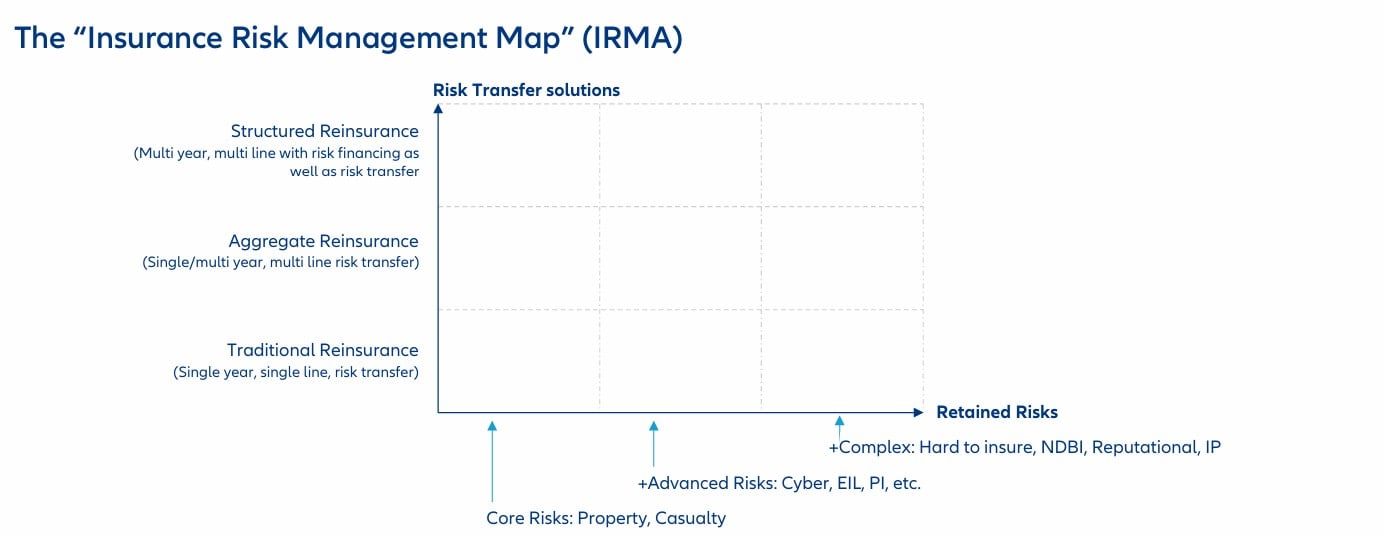
The 3 levels of sophistication regarding retained risks
Core risks: typically include Property or General Liability. Sometimes Work Comp is also part of retained basic risks.
Advanced risks: such as Cyber Insurance, Environment Impairment Liability (EIL), Product Liability.
Complex risks: and hard to insure risks. Can include Non-Damage Business Interruption (NDBI), Reputational and Regulatory Risks, or Intellectual Property Protection.
The 3 levels of sophistication regarding risk transfer solutions
Traditional (re)insurance solutions: Typically, single year/single-line risk transfers, like stop-loss covers.
Aggregate (re)insurance solutions: Typically, multi line/single-year stop losses, as well as single-line/multi year covers.
Structured (re)insurance solutions: Typically, structured multi-line/multi-year solutions covering a substantial number of lines, as well as bespoke client solutions such as risk financing elements. These can include significant profit commissions, resulting in strong alignment between the carrier and client.
A typical risk management evolution
By looking at a typical journey of increasing risk management sophistication, we can begin to understand the differences between each of the nine positions on the IRMA matrix.
In the below example, the company (known as PharmCo) is:
- A large international company and traditional insurance buyer, with substantial insurance capacity across typical lines of business, structured in layered towers (or co-insurance solutions).
- Looking for an International Insurance Program (IIP) that ensures coverage and policy issuance in all relevant countries.
- Works with multiple insurance companies and markets to meet capacity needs and diversify its risk appropriately.
- Faces increasing pressure from insurers to retain more risks, and so has set up a Captive insurer.
A typical journey of increasing sophistication

Step 1: Setting up a Captive
By setting up a Captive, PharmCo moves to the bottom left field of the IRMA. It retains property risks and some casualty risks. The benefits to PharmCo include the ability to leverage and deploy its own risk bearing capacity, using insurance as a risk management tool in a more cost-effective way. PharmCo also gains direct access to reinsurance markets, resulting in better pricing and reduced exposure to volatility in the commercial insurance market.
The Risk Manager also wants to protect the capital of the captive. Here, traditional reinsurance can be used – for example, to provide frequency protection in the event of an unexpectedly high number of losses (stop loss), or to buy down the per occurence retention in the captive.
Step 2: Broadening use of Captive
The Captive provides PharmCo with several benefits, including better control over insurance costs, policy wordings and scope of cover. It also allows the company to retain underwriting profits, resulting in lower costs and more stable premiums.
PharmCo opts to use the Captive for additional LoBs, extending its use for Cyber Insurance, Construction, and Product Liability. Additional LoBs require additional capital, but savings on insurance premiums and premium stability support this business case. PharmCo therefore moves one field to the right on the IRMA and continues to purchase reinsurance coverage for the newly added lines.
Step 3: Multi-line annual stop loss
PharmCo has now bundled five lines of business in its Captive with significant premium volume. While, PharmCo continues to buy traditional reinsurance by LoB, it realizes that the annual renewal of multiple reinsurance covers is cumbersome and does not capture diversification benefits resulting in higher-than necessary underwriting profits being ceded to reinsurers.
To reduce these costs and keep the Captive protected from adverse loss scenarios, PharmCo implements a multi-line/single year stop-loss. See exhibit X.
With this solution, PharmCo moves up one field to the middle field of the IRMA.
Step 4: Moving to a multi-line/multi-year structured reinsurance solution
PharmCo now has a deep understanding of the benefits of more sophisticated risk transfer solutions. To further optimise it opts to implement a multi-line/multi-year structured reinsurance solution covering five different LOBs with a five year term. This reduces the burden and uncertainty of annual renewals, provides stability in budgets and premiums, and makes the individual IIPs attractive to insurance markets. Higher profit commissions also allow PharmCo to benefit from absence of losses.
The implementation of this solution moves PharmCo to the top-row/middle box on the IRMA.
Step 5: Establish solutions for hard to insure elements
PharmCo’s key entrepreneurial risk resides in its research pipeline and cannot be transferred to insurance markets. However, PharmCo lists other risks that it wants to transfer to insurance markets where the market doesn’t want to accept the risk due to volatility, or where often no or not enough data is available to calculate the insured risk (e.g., reputational risk or protection of intellectual property).
On the back of the existing multi-line/multi-year structured reinsurance contract, a solution for this hard to insure risk is agreed between PharmCo and Allianz Commercial.
This provides PharmCo with two benefits: First, any loss in this risk category would not result in an earnings impact for the PharmCo, as the Captive would pay PharmCo’s corresponding claim, like any insurance policy would do offsetting the loss impact. Second, by putting those risks under a formal insurance contract, PharmCo will build up a data record, meaning it will likely be able to transfer such risk to an insurer after a number of years. See exhibit Y.
The introduction of this risk-financing component for hard to insure risks moves PharmCo to the top right box in the IRMA matrix.