
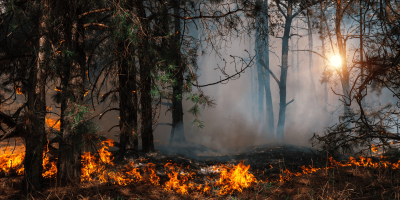
Forest fires, bushfires, or wildfires – the terminology changes, but the damage they wreak is the same, including loss of life, damage to property, air pollution, and the destruction of habitats. Allianz Commercial experts discuss the complex issues surrounding this natural catastrophe.
Wildfires: climate change and human activity fan the flames
Expert risk article | June 2024
The 1 minute dialogue
- Record-breaking fires are occurring more frequently and in landscapes that were previously rarely affected.
- Climate change, land use, human activities, invasive species, and previous fire suppression policies have made some landscapes more flammable.
- A wildfire can impact multiple insurance lines, with insureds being both an initiator and a casualty of wildfires.
- Legislation is driving a duty of care, especially around building standards, land management, and fuel reduction.
Australians often describe their land as a “sunburnt country”, but these days, their landscape is often more charred and smoking than well-tanned. Wildfires have always been a hazard Downunder. It comes from being the driest continent on earth (excluding Antarctica) combined with high temperatures and vegetation evolved over eons to need regular burning for its propagation.
Yet the nature of wildfires in Australia (and elsewhere) is changing. In some locations wildfires are becoming more frequent and intense every year. Data shows fires such as those experienced in Australia today are four times more likely than in pre-industrial times. [1] Wildfires are also burning larger areas, and the time between fires in the same area is getting shorter, which means places are burning more frequently than before. [2]
“Historically, Australia has been a ‘tinderbox’ in summer,” says Basil Taylor, Head of Risk Consulting at Allianz Australia. “But we are now seeing that when losses arise from bushfires, they are much more severe, and the time it takes a fire to go from zero to severe is much shorter.”
During the last devastating season (2019-2020), known as the “Black Summer”, fires burnt nearly 21mn acres (8.5mn hectares) of forests, mainly in New South Wales, as well as in Victoria and Western Australia. [3] In New South Wales, the location of the greatest human impact, over 13.5mn acres (5.52mn hectares) of land burnt, 26 lives were lost, and 2,476 homes were destroyed. Thousands more buildings were damaged. [4] The last of the bushfires were extinguished in New South Wales on March 2, 2020, after 240 consecutive days of burning. [5]
To put Black Summer into context, the 2018 California fires that hit worldwide headlines saw nearly 2mn acres (800,000 hectares) burn. The 2019 Siberian fires covered 6.7mn acres (2.7mn hectares). Taylor explains the Black Summer was the largest natural catastrophe in Australian history, incurring around AU$2.6bn ($1.71bn) losses for the insurance industry. [6] The extent of forest burnt was greater than in any year since the early 1930s. [7]
Across the Pacific, a similar trend is evident. While the number of wildfires in the US has declined slightly over the last decade, the area burnt each year and the average size of wildfires have increased since the late 1990s. The number of fatalities and property losses also increased after 2017, with four of the five years from 2017 to 2021 being considerably worse than any year since at least 1990. [8]
Globally, it is estimated 5% of wildfires start naturally. In the US, 85% of wildfires are estimated to be started by humans, with more than half of wildfires in Canada, which has a much lower population density, sparked by lightning. [9]
“Wildfires can be natural occurrences, but the kind of behavior and the times, places and conditions they are igniting in are becoming more unusual,” says Jenise Klein, Regional Head of Property for North America at Allianz Commercial. “Look at the catastrophic wildfires of Hawaii in 2023. They occurred in a place that, while it had a history of wildfire, had not experienced such catastrophic events historically, and the loss of life and property was on a scale not experienced before.”
Our flammable landscapes
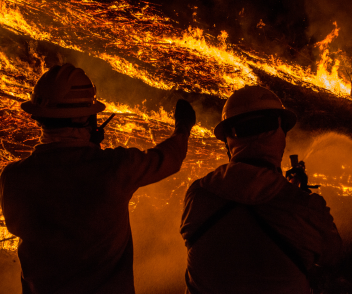
Photo: Patrick Ryan / Adobe Stock
It is easy to pinpoint a key cause for the changing pattern in wildfires – climate change. Scientists have long predicted a consequence of this would be an increase in the frequency, intensity, and pervasiveness of wildfires worldwide. Today, record-breaking fires are appearing more frequently, and on scorching landscapes that were once rarely touched by flames.
In Australia, the Royal Commission and Senate Inquiry into the 2019/2020 New South Wales Bushfires found climate change is driving extreme weather and leading to worsening bushfire conditions by creating, among other things, drier vegetation and fuel. [10]
Severe weather pattern changes are also believed to play a role in increasing North American wildfire risks in areas previously deemed ‘low risk’. These include the Appalachians, Southern Rocky States, Texas, Alberta and British Columbia, which are becoming areas of concern for catastrophic wildfire insurance losses. [11]
The year 2022 was the third in a row that unprecedented wildfire events caused significant environmental and economic damage in the European Union, specifically Italy, Greece, Portugal, and Spain. Some 2mn acres (800,000 hectares) burnt, almost two and a half times as great as the average for the previous 15 years. [12] Recent blazes in Argentina and Chile show South America is also being impacted.
The size of these often-uncontrollable fires has led to new terminology in the firefighters’ lexicon: a ‘megafire’ is when more than 100,000 acres (41,000 hectares) of land burns in a single fire, while a ‘gigafire’ is a newer term for a monster that burns over 1mn acres (about 405,000 hectares). Gigafires remain rare but their frequency is increasing. Six of the 12 largest megafires on record worldwide have occurred in the last 20 years. [13]
“When such fires occur in close proximity to the wildland-urban interface – that is, the populated areas on city fringes adjoining vegetated areas – the results in terms of loss of life and property have been catastrophic, as seen in recent years in Australia, North America and the Mediterranean region,” says Tom Carmichael, Senior Risk Engineer, Liability, at Allianz Risk Consulting.
“Understandably, the insurance and reinsurance industries are becoming intensely interested in wildfires because they are affecting so many of our clients,” adds Jamie Mullarkey, Global Industry Sector Leader, Property, at Allianz Commercial. “In particular, it is clients in agriculture, forestry and utility sectors and nearby communities that often experience losses.”
Other businesses affected include hotels, ski resorts, and wineries, which are often surrounded by trees and crops. Renewables companies with wind and solar farms in remote locations can be particularly vulnerable, as solar panels and wind turbines can spark fires.
Modeling the risk
Mullarkey explains far more interest is being applied to modeling wildfires than a decade ago. “However, modeling the potential insured losses from wildfires is extremely difficult. It is not as probabilistic as hurricanes or earthquakes.
“The large number of human-made and natural factors make this risk exceedingly complex,” Mullarkey explains. “Still, the industry is continually developing and updating hazard zones and loss simulation models to improve risk assessment, but we are probably still in a reactive phase.”
Klein adds that in addition to climate change, four factors make landscapes more flammable: land use, human activities, invasive species, and past fire suppression policies.
“As our urban areas expand into wildland, it can increase the likelihood of fires because we disrupt natural fire regimes – the characteristics of fires in an ecosystem over a period of time – which can lead to more severe and less predictable fires,” Klein adds. “Invasive species can also play a role as they often grow more rapidly than native plants and can create conditions more prone to burning.”
Invasive grasses played a significant role in the 2023 Hawaii wildfires that destroyed the town of Lahaina, claiming over 100 lives. For example, Guinea grass can reach a height of 10ft (3m). Such grasses tend to dry earlier in summer and decompose more slowly, which creates readily burnable fuel.
Klein explains that past fire suppression policies aimed at extinguishing wildfires as quickly as possible led to an accumulation of underbrush and deadwood in many forests. This build-up has created more combustible forests within increasingly populated regions.
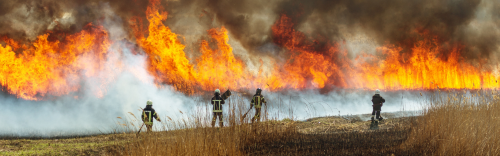
Photo: Aleksandr Lesik / Adobe Stock
Unique among the Acts of God
Climate change is intensifying the impact of many natural catastrophes. Flash, river, and surge flooding are becoming more destructive, hurricanes more intense, and droughts are longer and more severe.
However, Carmichael adds: “Wildfire is unique among other ‘Acts of God’ in that humans have the ability to directly cause wildfire events, but also in many cases stop or reduce the scale of them. The role of humans introduces insurance liability exposures to parties whose activities might trigger wildfires.”
Companies in Australia and the US have been subject to litigation because of negligence. One Australian grid operator was hit with two class actions from the devastating 2009 Black Saturday bushfires [14], Carmichael explains. “The settlement was AU$300mn for one fire believed to have been started by a fault in an electrical conductor on a power pole. In a separate matter, the operator paid AU$378.6mn [15] to settle a claim against a fire caused by an ageing power line.”
In California, PG&E, the state’s largest utility company, filed for Chapter 11 bankruptcy in January 2019 after facing potential liabilities of $30bn from several fires. [16] These included the November 2018 Camp Fire, the deadliest and most destructive in Californian history.
“Wires wear and can clash in strong winds, poles may fall if not properly maintained, and lines sag in hot weather, all of which may result in electricity arcing into nearby vegetation and igniting a wildfire,” says Carmichael. “Given the increasingly litigious nature of society, liability insurance is a must for companies that operate outdoors in rural settings and in the wildland-urban interface. After a fire, there will be conjecture about who was responsible, especially if a company has failed to meet what is considered due care and obligation.”
Preparing for fire
Given the changing nature of wildfires, companies must assess their potential exposure and develop appropriate plans to mitigate risks. They need to think about resilience and sustainability and determine how the environment around their assets is changing, says Mullarkey.
“This is not just exposure of assets but also their supply chain,” Mullarkey explains. “If a key company that makes a specific component goes down, it can close a manufacturer for several months. As we insure against such losses, we are looking at the complexities of wildfires far more intensively and educating our underwriters to do the same.”
Carmichael says: “The triggers for wildfires and their behavior once they start are complex. Companies need an organizational understanding about the threats of first- and third-party exposures, including how they could trigger or exacerbate a wildfire event. They also require comprehensive risk mitigation planning and to be assured of external support from their insurers and research and emergency response organizations.
“A destructive wildfire can impact multiple insurance lines, more so than other nat cat events,” Carmichael adds. “In some events, insureds can be both an initiator and a casualty of wildfires.”
Changing regulations
In response to wildfires, policies and regulations are changing on both sides of the Pacific to manage and mitigate the risks. Following the Black Summer bushfires, Australian states have proactively reviewed and adjusted their fire management and land use policies, especially regarding building codes and standards and land management and fuel reduction.
Similar trends are observable in the US, where states like California have tightened regulations on utilities, requiring them to update equipment, implement power shutoffs under extreme fire risk conditions, and better manage vegetation around power lines.
“What is best practice is something of a moving target,” says Carmichael. “Wildfires are likely to remain low frequency but high impact, so how much resource do you devote to mitigation and preparation compared to high frequency, low impact events? It can be a tough line for companies to walk. Still, the trends are clear: wildfire risks are increasing, legislation is driving a duty of care, and companies need to be on top of this.”
Seven steps to prepare for a wildfire
1. Create defensible space
2. Reduce organic fuel
3. Use non-combustible materials for building signage
4. Consider the exterior walls
5. Consider the windows
6. Cover the roof with non-combustible material
7. Inspect vents and clear fuel from roofs
More information on these precautionary measures is featured in the updated Wildfire Readiness risk bulletin from Allianz Risk Consulting
This article is taken from the latest edition of Allianz Commercial's biannual client publication, Global Risk Dialogue, which features a number of insights on risk management and insurance topics around the world.
For more information download our Wildfire Readiness risk bulletin.
References
[1] Munich Re, Wildfires and bushfires: Climate change increasing wildfire risk
[2] Nature.com, Multi-decadal increase of forest burned area in Australia is linked to climate change, November 26, 2021
[3] Australian Department of Agriculture, Fisheries and Forestry, Forest fire area data for the 2019-20 summer bushfire season in southern and eastern Australia
[4] NSW Government, Final Report of the NSW Bushfire Inquiry, page 2, July 31, 2020
[5] NSW Government, Final Report of the NSW Bushfire Inquiry, page 1, July 31, 2020
[6] Insurance Council of Australia, Insurance Catastrophe Resilience Report: 2022-2023, September 12, 2023, losses for the states of New South Wales, Queensland, South Australia, and Victoria. Adjusted for inflation
[7] Nature.com, Multi-decadal increase of forest burned area in Australia is linked to climate change, November 26, 2021
[8] National Oceanic and Atmospheric Administration, National Centers for Environmental Information, Billion-Dollar Weather and Climate Disasters
[9] Swiss Re, Natural catastrophes in focus: Wildfires, December 14, 2023
[10] 2019/2020 NSW Bushfire Coronial Inquiry, Inquests and Inquiries into the 2019/2020 NSW Bushfire Season, Findings and Recommendations, Volume 2, page 15, NSW State Coroner, Coroners Court of New South Wales, March 2024
[11] Chaucer, Severe weather patterns are playing a key role in increasing North American wildfire risk in previously ‘low-risk’ areas, November 6, 2023
[12] Munich Re, Wildfires and bushfires: Climate change increasing wildfire risk
[13] Earth.org, Top 12 largest wildfires in history, September 4, 2022
[14] The Guardian, Black Saturday bushfire victims agree $300m settlement with AusNet, February 5, 2015
[15] Australian Financial Review, Black Saturday bushfire case settled for $500m, July 15, 2014
[16] The New York Times, PG&E’s bankruptcy filing creates ‘a real mess’ for rival interests, January 29, 2019
Stage image: Lumppini / Adobe Stock




All the latest news, reports and hot topics



Sign up to the newsletter
Keep up to date on all news and insights from Allianz Commercial