
World Ocean Day catalyzes collective action for a healthy ocean and a stable climate. To mark it, Allianz Commercial Global Head of Marine Risk Consulting, Captain Rahul Khanna, who sailed on vessels for 14 years, looks at how the maritime industry is faring on its decarbonization journey and outlines how going green will change the face of shipping.
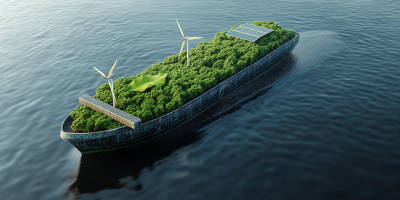
Decarbonization and sustainability in shipping
Expert risk article | June 2024
How has the perception of sustainability in the shipping industry changed since you were at sea? What are some of the main differences? Why is a greener fleet essential for a cleaner ocean?
Captain Rahul Khanna
Captain Rahul Khanna: "During the early 1990s sustainability was only a word and had little to do with shipping. The industry’s biggest concern was oil pollution. Air pollution was not on the agenda at all. The International Convention for the Prevention of Pollution from Ships (MARPOL) Annex VI regulations which deal with air pollution were proposed in 1998 and came into force only in 2005. Even then the focus was not on greenhouse gas emissions (GHGs) but on sulphur and nitrogen oxides in ship’s exhausts. Sustainability in shipping as we know it today has only taken the center stage in the last decade. And since then, so much has changed. Three key examples are:
- Awareness – understanding of climate change and sustainability has exponentially improved.
- Regulation – a plethora of regulations are now in place, from measuring what we emit into the atmosphere to limiting the amount of GHGs vessels will be allowed to emit.
- Technology – the development of alternative fuels, such as methanol and ammonia.
The mindset of the industry is completely different – from being ignorant about damage to the environment, to discovering new fuels and ship designs to help enable a greener future. It also started working on correcting the pollution of oceans by plastics disposal into seas long ago and has continued its efforts in this direction. However, shore side establishments need to do a lot more.
A greener fleet of ships is crucial for cleaner oceans because it reduces air and water pollution, mitigates climate change, protects marine ecosystems and biodiversity, and supports sustainable coastal communities and economies."
What are the some of the main drivers behind the shipping industry’s drive to decarbonize?
Captain Rahul Khanna: "Shipping plays an essential role in the economy and is one of the most energy-efficient modes of transport. However, it is responsible for around 3% of global emissions caused by human activities.
While it has been making progress on its decarbonization journey, ambitious new targets from the International Maritime Organization (IMO) and regulators have raised the stakes. For example, the industry is now committed to reaching net-zero GHG emissions by around 2050, and to transition towards alternative or near-zero GHG fuels by 2030, meaning it has limited time to achieve these goals, as well as checkpoints on the way. Shipping companies cannot achieve the IMO targets on their own. They will need to quickly step-up levels of investment, innovation, and collaboration.
Reaching these targets will require a mix of strategies, including measures to improve energy efficiency, the adoption of alternative fuels, innovative ship design and methods of propulsion. Insurers like Allianz are supporting the industry as it experiments with biofuels, ammonia, methanol, and green hydrogen, as well as electric vessels and wind assisted propulsion systems, such as wing sails, rotors, and foils."
What are some of the main challenges that the transition to greener shipping poses for the shipping industry?
Captain Rahul Khanna: "Decarbonization presents various challenges for an industry juggling new technologies alongside existing ways of working. For example, the industry will need to develop infrastructure to support vessels using alternative fuels, such as bunkering and maintenance, while at the same time phasing out fossil fuels.
Shipping companies are increasingly investing in alternative fuels, yet there is presently no single clear technical solution. Potentially, the industry is heading for a multi-fuel future. The challenge for insurers is that we do not yet know what the impact of alternative fuels will be as we have little historical data from these in marine applications. There may be potential safety issues with terminal operators and vessels’ crews handling alternative fuels that can be toxic or highly explosive, for example.
Increasing shipyard capacity will also be key as the demand for green ships accelerates. Such capacity is currently constrained with long waiting times and high building prices. Over 3,500 ships must be built or refitted annually until 2050, yet the global shipbuilding industry built 2,700 vessels a year at its peak in 2010, while the number of shipyards more than halved between 2007 and 2022 [1]. At the same time capacity constraints on shipyards could have a knock-on effect for repairs and maintenance, with damaged vessels or those with machinery issues potentially facing long delays. Machinery damage or failure is already the most frequent cause of shipping incidents, accounting for over half of all incidents globally in 2023 (1,587).
Finally, decarbonization is not just a challenge in terms of capital investment, we also need people who are trained and skilled to operate in this new shipping environment. The industry was already struggling with talent shortages. Recent stresses on the industry caused by Covid-19 pandemic, war in Ukraine, and attacks on merchant vessels in the Red Sea have not improved this situation."
How optimistic are you about the prospects for greener shipping? What has the industry done well so far on its decarbonization journey? What else can insurers do to help?
Captain Rahul Khanna: "There is no doubt that this is the biggest challenge we face. The industry took time, but it has now taken up the challenge of achieving net zero and has recognized the urgency of the situation, committing to research and development, with good collaboration between stakeholders. I feel there has been substantial progress in the last five years and the industry continues to up its game. The scale of work ongoing in various fields, whether we are talking about alternative fuels, efficiency improvement initiatives or alternative propulsion methods, such as wind rotors, is impressive. Despite not having a definitive solution in sight, huge efforts are ongoing, and I am optimistic for the future.
Greener shipping is a high priority for shipping companies and insurers alike. From a marine insurance perspective, we are increasingly looking at clients’ sustainability approaches and seeing where these sit with our own strategy. But it is important to recognize that you cannot look at every shipping company with the same expectations. Different clients and segments will move at a different pace, while technical and commercial challenges will affect the speed of transition. As an insurer, we stand with our clients during this transition, will continue to support them as they decarbonize, and are seeking to provide coverages to respond to risks linked to climate change and sustainability requirements. Insurers can provide peace of mind to our clients through risk transfer while they experiment to find the right solution for their company. It is important we work together."
References
[1] UNCTAD, Review of Maritime Transport 2023, Towards a green and just transition
Pictures: Adobe Stock
Join our online webinar: "Maritime trends to watch"
Monday, June 17, 2024 | 3-4 pm CEST
Allianz Commercial marine experts will discuss the latest trends in the maritime industry, as well as the outlook for insurance and claims for 2024 and beyond.
All the latest news, reports and hot topics
















Sign up to the newsletter
Keep up to date on all news and insights from Allianz Commercial