
Article | January 2025

Allianz Risk Barometer 2025 -
Global risk #3: Natural catastrophes (29%)
For the fifth consecutive year, insured losses due to natural catastrophes have surpassed the US$100bn mark. As such, it is no surprise that natural catastrophes remain among the top three concerns in this year’s Allianz Risk Barometer.
This article is part of the Allianz Risk Barometer 2025
An above-average hurricane season that featured events like Helene and Milton in the US, Storm Boris in Europe, widespread flooding in several countries and the Noto Peninsula Earthquake in Japan serve as reminders that natural catastrophes are a major threat for both companies around the world and the insurance industry.
Total economic losses from natural catastrophes alone reached $310bn in 2024, according to Swiss Re [1]. Severe convective storms (SCS), tropical cyclones and flooding events accounted for almost 90% of all global insured losses related to natural perils and 85% of the total economic losses associated with natural hazards. SCS was the costliest peril, with $57bn, $51bn of which occurred in the US alone. This is the second consecutive year that SCS losses in the US have surpassed the $50bn threshold [2].
2024 is projected to be the warmest year on record, marking the first-time global temperatures exceed 1.5°C above pre-industrial levels (1850-1900) [3]. Weather and climate events accounted for at least 95% of the insured losses in the first three quarters of 2024, with $103bn. Moreover, every major continent experienced at least one historically anomalous extreme weather or climate event during this year. [4]
“As climate change progresses, extreme weather events like floods and droughts are expected to become more severe and frequent, a reason why climate change has also risen to #5 in the Allianz Risk Barometer ranking,” says Mabé Villar Vega, Senior Catastrophe Risk Research Analyst, Allianz Commercial. “Rapid urbanization and significant changes in land use further contribute to increasing losses. Therefore, it becomes essential to plan and invest in resilience measures to mitigate the effects of a changing climate.”
Overview
Natural catastrophes (e.g., storm, flood, earthquake, wildfire, extreme weather events)
Ranking history:
- 2024: rank 3
- 2023: rank 6
- 2022: rank: 3
- 2021: rank 6
- 2020: rank 4
Top risk in:
- Austria
- Croatia
- Greece
- Hong Kong
- Japan
- Romania
- Slovenia
- Spain
- Turkey
Major events in 2024
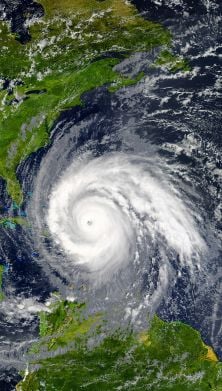
Hurricane Helene made landfall as a Category 4 storm in the Big Bend area of the Florida Gulf coast in September, bringing damaging winds and storm surge. The most severe impacts were felt across the southern Appalachians, where record-breaking flooding resulted in hundreds of fatalities and billions in property damage. Economic losses are currently estimated in the range of $56bn, while insured losses are close to $16bn [5].
Hurricane Milton: just two weeks after Helene, Milton made landfall as a Category 3 storm in Sarasota County, Florida, after becoming the fastest Atlantic storm to intensify from tropical depression to a Category 5 hurricane. Economic losses are currently estimated in the range of $38bn, with insured losses of $25bn, the costliest storm of the year for insurers [6].
Severe convective storms in the US continue to drive losses for the second consecutive year. More than 1,600 events have been reported during 2024, at least 15 of them have caused losses of S1bn+, with two individual events reaching at least $5bn each. The US SCS combined loss for 2023 and 2024 is now above $114bn, a threshold that had only been breached twice on the US mainland for tropical cyclone (2004/2005 and 2020/2021) [7].
Natural catastrophes in Canada have resulted in the most expensive year on record for insurers, with losses exceeding US$6bn. The Calgary hailstorm in August, with hailstones exceeding 7cm, became the country’s costliest insured SCS event on record, with $2.2bn. Extreme rainfall caused by Hurricane Debby’s remnants led to considerable flooding in Ontario and Montreal, which resulted in insured losses above $1.9bn [8]. Other notable events include Toronto floods and the Jasper Wildfire, both in July.
Storm Boris: a very slow-moving low-pressure system caused torrential rains and caused considerable flooding in Poland, the Czech Republic, Slovakia, Austria, Hungary, Slovenia, Romania, and Italy, among other countries. Insured losses are expected to range between $2bn and $3bn, with economic losses over $20bn. [9] Many areas in the Alps saw their earliest snowfall on record. However, recent investments in flood defenses, especially in major cities, effectively helped to reduce both economical and human losses, highlighting the importance of investing in resilience measures.
Other relevant flooding events include the severe flash flooding in eastern and southern Spain in October, which severely impacted densely populated areas such as Valencia and Alicante, leaving hundreds of casualties and insured losses expected to exceed $4bn [10]. In April, a flash flooding event in the Arabian Peninsula, led to the heaviest rainfall in 75 years of record-keeping in the United Arab Emiratesand insured losses of almost $3bn [11]. In southern Brazil, extreme rainfall led to the worst flooding event in Porto Alegre in more than 80 years. Millions of hectares of crops were lost, and insured losses are estimated to reach $2bn, making it the costliest flood event on record. In Africa, the northward shift in the monsoon brought significant rainfall to the Western Sahara, leading to an extreme flood season that caused widespread damage to thousands of homes, livestock, and agriculture. In Chad, Nigeria, Mali and Niger, rainfall totals were among the heaviest seen in decades. [12]
Asia saw two of the most relevant earthquakes in 2024: a M7.5 in the Noto Peninsula, Japan, resulted in insured losses of $3bn [13], with economic losses reaching $12bn. In Hualien, Taiwan, a M7.4 struck in April, leading to economic losses of at least $3bn .
Typhoons Yagi, Gaemi and Shanshan affected several areas in the Philippines, Vietnam, China, Thailand, Myanmar, Taiwan, North Korea, and Japan. The combined economic loss of landfalling typhoons in East Asia is estimated to surpass $20bn. Yagi, the second strongest tropical cyclone globally in 2024, only behind Hurricane Beryl, became Vietnam’s costliest weather event, with an economic loss of $3.3bn. [14]
Wildfire: devastating wildfires in the Chilean regions of Valparaíso, O’Higgins and Araucanía [15] resulted in more than $1bn in economic losses and 134 fatalities . In Brazil, a record-breaking number of wildfires caused widespread damage, deteriorated air quality and generated hundreds of millions of dollars in economic losses.
Drought events in the central and western US are expected to result in a multi-billion-dollar economic loss. Severe conditions also impacted the Amazon River basin and the Pantanal Wetlands in South America as well as much of southern Africa.
Main natural catastrophe perils in 2024

Sources: Gallagher Re, Natural Catastrophe and Climate Risk Report: Q3, 2024; Insurance Asia, Typhoon Gaemi causes multi-millio-dollar losses in Asia; Artemis, Typhoon Shanshan sees as unlikely to touble cat bonds or ILS positions; Southbridge, Mayor aseguadora contra incendios: "Hemos recibido pocas denucias de siniestros...habíe bajacobertura"; Reuters, Economic impact of floods in Spain could rise to over 10 bln euros, November 5, 2024.
Graphic: Allianz Commercial.
Graphic: Allianz Commercial.
Further information
[1] Swiss Re, Hurricanes, severe thunderstorms and floods drive insured losses above USD 100 billion for 5th consecutive year, says Swiss Re Institute, December 5, 2024
[2] Gallagher Re, Natural Catastrophe and Climate Report: Q3 2024, October 2024
[3] Copernicus, The year 2024 set to end up as the warmest on record, November 7, 2024
[4] Gallagher Re, Natural Catastrophe and Climate Report: Q3 2024, October 2024
[5] Munich Re, 2024 tropical cyclone season leaves above-average losses in its wake, December 3, 2024
[6] Munich Re, 2024 tropical cyclone season leaves above-average losses in its wake, December 3, 2024
[7] Swiss Re, Hurricanes, severe thunderstorms and floods drive insured losses above USD 100 billion for 5th consecutive year, says Swiss Re Institute, December 5, 2024
[8] Swiss Re, Hurricanes, severe thunderstorms and floods drive insured losses above USD 100 billion for 5th consecutive year, says Swiss Re Institute, December 5, 2024
[9] Gallagher Re, Natural Catastrophe and Climate Report: Q3 2024, October 2024
[10] Reinsurance News, Insured losses from Spain flooding expected to exceed €4bn: Morningstar DBRS, November 14, 2024
[11] Intelligent Insurer, Insured property & auto losses on UAE floods could near $3bn, June 13, 2024
[12] Gallagher Re, Natural Catastrophe and Climate Report: Q3 2024, October 2024
[13] Gallagher Re, Natural Catastrophe and Climate Report: H1 2024, July 2024
[14] Gallagher Re, Natural Catastrophe and Climate Report: Q3 2024, October 2024
[15] Gallagher Re, Natural Catastrophe and Climate Report: Q1 2024, April 2024
Picture: Shutterstock
Our expert

All the latest news, reports and hot topics













Sign up to the newsletter
Keep up to date on all news and insights from Allianz Commercial