
Article | September 2025

Hot seas, heatwaves and “medicanes”: the consequences of a cruel summer
The first half of 2025 has seen record-breaking sea surface temperatures across the Mediterranean Sea. But what are the consequences of this and what does it mean for different economic sectors, including insurance?
It has been another record-breaking summer in Europe. During June (2025), most of the Mediterranean basin experienced temperatures well above the average. Some regions, like the Gulf of Lion and the Ligurian Sea, exceeded the average temperature by more than 5°C (see figure 1), and for the first time, the western Mediterranean registered a daily sea surface temperature (SST) of 27°C in June.
When SSTs are warmer than usual, they pump heat and moisture into the atmosphere, raising humidity and nighttime temperatures (suppressing nighttime cooling and keeping minimum temperatures higher). They also weaken the sea’s natural cooling effect along coasts and reinforce high-pressure “heat dome” systems that trap hot air. Together, these processes amplify the intensity and duration of heatwaves on land [1].
According to the latest Climate Bulletin by the Copernicus Climate Change Service, June 2025 was the third warmest June on record globally. The high SSTs in the western Mediterranean Sea intensified two major heatwaves in June and early July, which affected large parts of western and southern Europe. The heatwaves brought “feels-like” temperatures corresponding to “very strong heat stress” (that is, above 38°C) to most of the affected regions. Some areas in Portugal even reached “extreme heat stress”, with feels-like temperatures close to 48°C [2].
Why are heatwaves so hazardous?
Heatwaves pose a risk to human health. It is estimated that as many as 95% of the fatalities associated with weather and climate-related extremes recorded in Europe between 1980 and 2023 were associated with heatwaves. In 2022 alone, there were between 60,000 and 70,000 fatalities linked to heat in Europe [3]. It is likely that the increased heatwaves will bring implications for casualty insurance unless proper guidance and legislation are put in place [4].
Elderly people, children, pregnant women, workers in physically demanding occupations, marginalized and under-resourced people are among the most vulnerable groups when exposed to heat. The impact of heat represents an additional burden for healthcare systems because it can lead to increased hospital admissions.
As well as affecting human health, heatwaves can lead to economic losses. Their negative impacts on wellbeing can reduce labor supply and productivity, while increasing the likelihood of workplace accidents and injuries. Additionally, failure to provide safe workplace conditions under high temperatures could result in impacts to employers’ and/or management liability insurance [4].
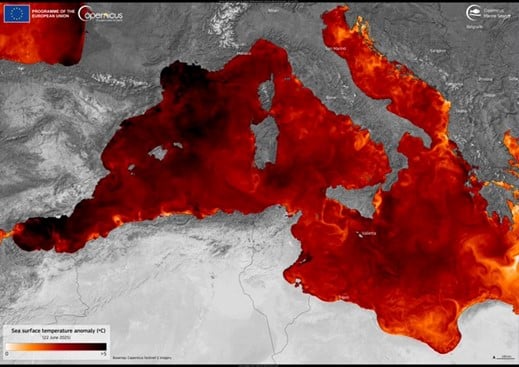
Figure 1. Mediterranean Sea surface temperature (SST) anomalies on June 22, 2025.
Source: Copernicus, June 25, 2025
Power demand (largely for cooling) and risk of thermal and nuclear plant outages can also increase during heatwaves. In the recent June/July 2025 heatwave, all but one of France’s 18 nuclear facilities experienced reduced capacity [5]. Outages combined with increased power demand can ramp up the daily prices of electricity.
Transportation disruptions and damage to infrastructure, including roads, bridges, and railways, can result in economic losses during heatwaves. A study by Allianz estimated the recent June/July heatwaves could cost between 1.0% and 1.4% of the GDP in countries including China, Spain, Italy, and Greece. The US could see a GDP reduction close to 0.6%.
Heightened risk of floods and storms
The high SSTs in the Mediterranean could fuel severe weather, flooding events, and even “medicanes” (tropical-like cyclones in the Mediterranean Sea – see panel) through the coming late summer and autumn. Higher SSTs lead to higher dew points, meaning the air contains more moisture. Thunderstorms and medicanes draw their energy, at least partially, from warm, moist air. In September 2023, Medicane Daniel brought exceptional rainfall to Greece, resulting in insured losses close to US$440mn. After crossing the Mediterranean, Daniel made landfall in Libya, where the heavy rainfall led to the collapse of at least two dams, causing at least 4,300 confirmed fatalities (and up to 10,000 missing) and billions of dollars in economic losses [6].
Research has also shown that the intense convective conditions linked with high SSTs (known as sea surface fluxes) are associated with heavy rainfall, especially in late summer and autumn, which can in turn lead to destructive flooding events in areas of Italy, Spain, the Alps, and the western Balkans, among other regions. Recent examples of such events include the 2023 flooding in Slovenia and the 2024 flooding in Valencia, Spain, which resulted in insured losses close to US$350mn [7] and US$4bn [8] respectively.
In addition to heavy rainfall and flooding, the intense convective conditions favored by warm SSTs can also fuel the formation of severe convective storms (SCS), resulting in strong, damaging winds, tornadoes, and/or destructive hailstorms. Events like the unprecedented SCS in July 2023 in Northern Italy, which featured a record-breaking 19cm hailstone and combined insured losses exceeding US$3bn [9, 10] showcase how higher SSTs in the Mediterranean Sea can provide favorable conditions for more frequent and severe SCS events [11, 12].
What is a Medicane?
Medicanes (from Mediterranean hurricanes) are rare, intense, and destructive cyclones occasionally generated in the Mediterranean Sea. They occur mostly in the western Mediterranean and in the region extending from the Ionian Sea to the North African coast. Compared with tropical cyclones, medicanes are weaker and smaller in size [13]. The strength and duration of medicanes have been shown to depend significantly on SSTs [14].
The impacts on the environment
Warmer waters can reshape ecosystems and impact long-term environmental health. Higher temperatures and drier conditions increase the risk for wildfires. Between 2014 and 2023, the global cost of wildfires reached US$106bn in economic losses and US$74bn in insured losses [15]. The dry conditions recorded this summer (2025) have already favored the development of destructive wildfires in Portugal, Turkey, Greece, and Spain, among others.
Wildfires decrease the resilience of cities and ecosystems to future heatwaves. As the tree coverage decreases, local temperatures can be altered, resulting in warmer cities, a phenomenon known as the “urban heat island effect”. Wildfires also increase the emissions of air pollutants [16], worsening air quality. Other pollutants, such as ozone, accumulate during extreme heat conditions, further adding to lower air quality, especially in cities [17]. Cooling (and heating) systems in buildings and homes also contribute significantly to the release of harmful pollutants [18].
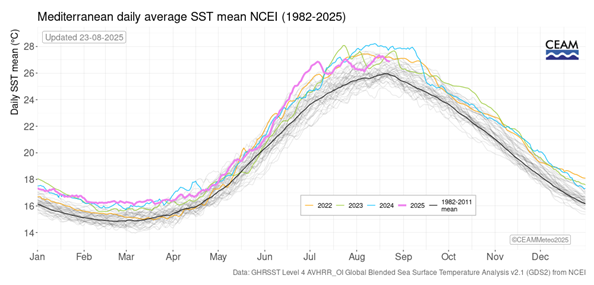
Figure 2. Average daily sea surface temperatures (SSTs) in the Mediterranean.
Source: CEAM Mediterranean Center for Environmental Studies
In addition, changes in sea temperatures can affect ecosystems, disrupting marine food webs. Native species, such as seagrasses, corals and clams, have declined throughout the Mediterranean region, which can lead to further impacts such as reduced fish catches. Changes in sea temperatures have also seen the arrival of invasive species which endanger native species and could pose a danger to human health if people are stung or eat them mistakenly.
Impact outside of the Mediterranean
Beyond the Mediterranean, climate-driven extremes are also posing challenges for other regions. According to the European and Global Drought Observatories [19], prolonged and critical drought conditions have been affecting large regions of central, northern, and eastern Europe as well as northern Africa, the Eastern Mediterranean, and the Middle East. In the UK, a drought was declared in the North West, Yorkshire, the East and West Midlands [20].
Between 1981 and 2010, the average drought losses in the European Union and the UK were €9bn annually. This figure could increase up to €15.5bn/year by 2050 under a 2°C warming scenario, according to a JRC Technical Report [21]. The main sectors affected would be agriculture, public water supply, and energy generation. As of July 2025, Canada, the US and some areas of South America were also experiencing drought conditions.
Insurers must adapt and evolve
“Climate change is leading to more frequent and intense extreme weather events: warmer heatwaves, more intense droughts, and heavier rainfall. These events not only pose a huge challenge to the resilience of communities but also demand innovative approaches from insurers, such as parametric insurance and incentives for implementing resilience-enhancing measures to effectively manage risk and ensure sustainable coverage,” says Mabé Villar Vega, Senior Catastrophe Risk Research Analyst, Allianz Commercial. “It is crucial that the industry evolves, by embracing new technologies, fostering collaborative partnerships, and investing in relevant research. By doing so, insurers can protect the future for policyholders and contribute to the global efforts to build a more resilient world. “
Allianz Commercial has launched its new Climate Adaptation and Resilience Services (CAReS) tool in order to help companies better assess and manage the climate risks facing their business. The data-driven platform allows companies to perform climate risk assessments for assets including their own locations, investments, and supplier locations. A dashboard solution can provide risk scores for 12 perils, such as tropical storms, floods, hail, wildfire, or extreme heat, for four different timelines – the present day, 2030, 2050, and 2080.
References
[1] Wired, Heat Waves Aren’t Just Getting Hotter — They’re Stickier Too, July 27, 2023
[2] Copernicus, Surface air temperature for June 2025
[3] Climate ADAPT, Heat, July 14, 2025
[4] European Heatwaves – Impact on Life Risks and Casualty Insurance
[5] Ember, Heat and power: impacts of the 2025 heatwave in Europe, July 4, 2025
[10] Gallagher Re, Natural Catastrophe and Climate Report: 2023, January 1, 2024
[11] Moody’s, Europe severe convective storms: Unpick the complexity with the latest risk models, May 27, 2024
[13] EUMeTrain, Medicane
[14] Nature, Effect of a positive Sea Surface Temperature anomaly on a Mediterranean tornadic supercell, October 9, 2017
[15] Swiss Re, 7 lessons learned from the California wildfires for European insurers, July 7, 2025
[16] European Environment Agency, Combined effects of air pollution and heat exposure in Europe: time for action, November 15, 2023
[17] World Meteorological Association, Extreme heat grips Europe, July 3, 2025
[18] European Commission, Air pollution from heating and cooling: stepping up clean energy use urgently needed, January 7, 2025
[19] European Commission, Drought in Europe June 2025
[20] BBC, Drought declared in Midlands after hot, dry weather takes its toll, July 15, 2025
[21] European Commission, JRC Technical Report, Global warming and drought impacts in the EU, 2020
Additional references
Photo: Adobe Stock

All the latest news, reports and hot topics



Sign up to the newsletter
Keep up to date on all news and insights from Allianz Commercial