
Article | January 2025

Allianz Risk Barometer 2025 -
Global risk #9: Political risks and violence (14%)
Political risks and violence drops one position but still ranks as a top five peril in countries such as France, Italy and the UK. The impact of civil unrest is the exposure companies fear most, while smaller firms are increasingly concerned about the disruption such threats can bring.
This article is part of the Allianz Risk Barometer 2025
Although political risks and violence drops one place globally in the Allianz Risk Barometer ranking year-on-year, it still has the same share of respondents as in 2024 and from a larger sample. It is also the third year in a row that this peril has ranked in the top 10 global risks, demonstrating that it has become a key concern for companies of all sizes.
The key drivers for the concern in 2024 were the record-breaking election year around the globe, the disputed results that stemmed from it, changing governments, developing conflict in the Middle East and escalation into Lebanon, as well as ongoing war in Ukraine. Companies, especially in the large-corp and mid-sized segments have also had one eye on potential miscalculation between China and Taiwan possibly escalating into a regional conflict.
“Political risks and violence remains a top 10 global risk because politics is increasingly perceived as being dominated by populism and blame and division, geopolitics by nationalism and a changing world order, and economics by mismanagement, corruption, and continually rising disparity between the ‘super rich’, ‘rich’ and the rest,” says Srdjan Todorovic, Head of Political Violence and Hostile Environment Solutions at Allianz Commercial.
“Ultimately, the speed of change we have seen since 2019, has given companies little time to address their supply chains, meaning they have had to operate in an uncertain environment. Another factor is the unpredictability of the size, location, and length of any incidents or issues. Unlike with other perils such as flood or windstorm, it is difficult to prepare in the same way to mitigate losses and build contingency and business continuity plans.”
Overview
Political risks and violence (e.g., political instability, war, terrorism, coup d'etat, civil unrest, strikes, riots, looting)
Ranking history:
- 2024: rank 8
- 2023: rank 10
- 2022: rank: 13
- 2021: rank 10
- 2020: rank 11
Top risk in:
Ivory Coast
Terrorism and sabotage challenges
Meanwhile, the risk of terrorism has increased, particularly in Europe. The risk around large events such as the Euros football tournament, the Olympics and Paralympic Games, and even Taylor Swift’s record-breaking world music tour have led to enhanced policing and security as well as the cancellation of shows. In March 2024, the tragic attacks on the Crocus City Hall in Moscow resulted in more than 140 casualties and numerous injuries, making it one of the deadliest terrorist attacks in Europe.
“Further, the risk of sabotage has also hit the headlines,” adds Todorovic. “Although this might appear to concern businesses in certain sectors more than others, especially those with offshore assets, like oil and gas, telecommunications, and power/utilities, the risk is actually much broader.”
For example, sabotage questions were raised around recent incidents impacting logistics company DHL in Birmingham, UK (a package fire in a warehouse) [1] and Leipzig, Germany (cargo plane crash) [2]. As war in Ukraine continues, and as key allies of Russia continue to suffer meaningful losses (for example, the overthrow of former President Bashar al-Assad in Syria) the risk of a broadening front for covert acts of sabotage by state actors such as Russia, Iran and North Korea will likely increase.
Which political risk and violence exposures are your company most worried about? (Top 5 responses)
Source: Allianz Commercial.
Figures represent how often a risk was selected as percentage of all responses. Respondents: 513. Figures don’t add up to 100% as up to three risks could be selected.
Figures represent how often a risk was selected as percentage of all responses. Respondents: 513. Figures don’t add up to 100% as up to three risks could be selected.
Civil unrest – the exposure of most concern
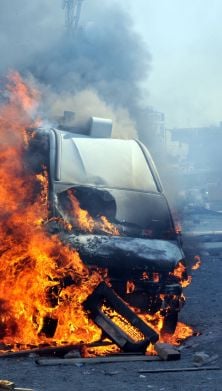
The impact of civil unrest or strikes, riots and civil commotion (SRCC) is the exposure companies fear most, according to the Allianz Risk Barometer with 51% of respondents ranking this top (see graphic).
“This is a view shared by insurers as we have seen this peril increase in frequency and severity over the last six years in particular,” says Todorovic. “Although SRCC in 2024 hasn’t hit the headlines in the same way, there have still been significant events and losses globally, with events in the UK, Kenya, New Caledonia and South Korea.”
In addition to endangering the safety of employees and customers, those in the immediate vicinity of unrest can suffer business interruption losses and material damage to property or assets, while indirect damage can be inflicted on companies in the form of ‘loss of attraction’ or ‘denial of access’ to their premises.
A rising risk for smaller companies
Political risks and violence is a risk riser for larger companies (US$500mn+), up to #7 year-on-year, given such firms can be impacted by events in different ways and regions. However, it is also a new entry in the top 10 risks for smaller companies (<US$100mn) at #10 and ranks #9 for mid-size companies (>$100mn to $500mn) globally.
Such companies tend to have a smaller footprint or a more regionalized focus which means that if their location is experiencing difficulty, it is much harder for them to mitigate potential risks such as damage to property, business interruption or disruption to supply chains and customers. They also have smaller budgets for risk management activities and to find alternative buyers or customers or relocate production.
“We continue to see greater engagement from the SME and mid-corp space about these risks, a true reflection of increasing concern in this segment,” says Todorovic.
Risk mitigation processes
Businesses need to protect their people and property with forward planning, such as ensuring safe and robust business continuity planning is in place in the event of an incident, increasing security, and reducing and relocating inventory if likely to be impacted by an event, according to Todorovic.
Monitoring of local and regional events and potential problems is also a small and inexpensive management tool, although the unpredictability of some political violence perils ultimately leave companies with little time to maneuver. Companies should also review whether their insurance policy covers the impact of risks such as strikes, riots, and civil commotion.
References
[1] Sky News, Counter-terror police investigate whether Russia was involved in suspicious package fire at DHL warehouse in Birmingham, October 17, 2024
[2] The Telegraph, Russia suspected of trying to parcel-bomb German aircraft, October 15, 2024
Picture: Shutterstock
Our expert

All the latest news, reports and hot topics









Sign up to the newsletter
Keep up to date on all news and insights from Allianz Commercial