Trends and developments in corporate insurance losses

Business interruption claims
Commercial Insights | September 2026
Business interruption (BI) – the financial loss a company suffers when its operations are disrupted – remains one of the most pressing risks facing businesses worldwide.
This report from Allianz Commercial includes analysis of 7,888 business interruption insurance industry claims valued at approximately €6.74bn (US$7.82bn) over the five-year period from January 2021 to December 2025. It reveals that while the frequency of business interruption claims has remained relatively stable, their severity is rising sharply, with the average claim value increasing by around 30% annually over the past two years alone.
The scale of the challenge
Business interruption and supply chain disruption ranks as the third most concerning risk in the Allianz Risk Barometer 2026, having featured in the top two in the annual survey for the past 15 years. It sits just below the closely related threats of artificial intelligence (AI) and cyber risk, underscoring how deeply interconnected today’s risk landscape has become.
The business interruption environment is challenging with geopolitical tensions, trade fragmentation, cyber-related incidents and growing dependency on technology such as AI. At the same time, many supply chains remain fragile with many organizations still focused on efficiency – holding less stock, streamlining operations and concentrating supply – which has effectively reduced the margin of safety and ability to mitigate disruptive events. Recovery is often taking longer and becoming more expensive, with supply chain constraints, inflation, and rising mitigation costs, all contributing to higher claim values than those seen just a few years ago.
The average 100% value of a business interruption insurance claim, including the share of other insurers on the same risk, now exceeds €850,000 – around 70% higher than the corresponding average property damage claim of close to €500,000. This gap highlights a critical insight: the financial impact of being unable to operate frequently dwarfs the cost of repairing the physical damage that caused the disruption in the first place.
Top causes of business interruption losses
By value of claims (% share of all claims)
Fire and explosion is the most expensive cause of business interruption claims globally analyzed by Allianz Commercial over the last five years, followed by natural catastrophe activity. Together, they account for over 75% of the value of all such claims analyzed in the portfolio between January 1, 2021, and December 31, 2025. Machinery breakdown ranks third.
By number of claims (% share of all claims)
Natural catastrophe activity is the most frequent cause of business interruption claims globally analyzed by Allianz Commercial over the last five years, followed by water damage, with fire and explosion ranking third. Together, they account for over 70% of the number of all such claims analyzed in the portfolio between January 1, 2021, and December 31, 2025.
Based on analysis of 7,888 insurance industry claims with a total value of approximately €6.74bn (including the share of other insurers in addition to Allianz Commercial) between January 1, 2021 and December 31, 2025.
Fire is the costliest cause
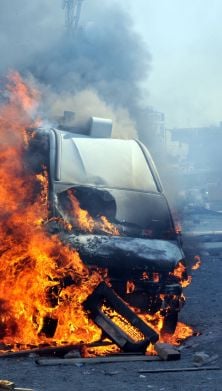
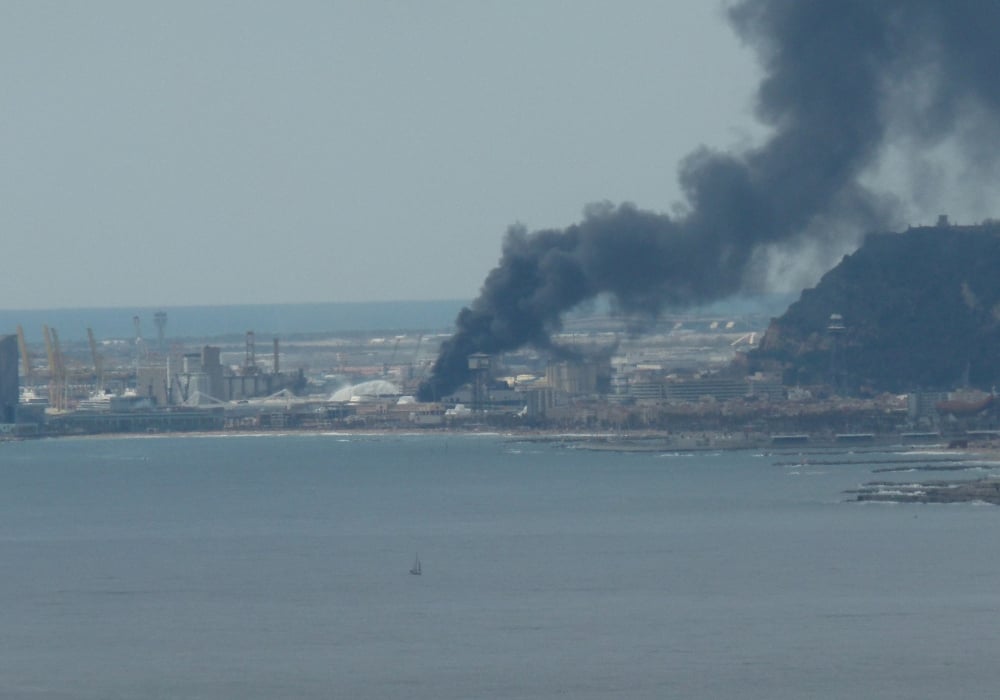
Fire and explosion is the single most expensive cause of business interruption claims globally, accounting for over 40% of the total value of all claims analyzed – equivalent to approximately €2.9bn (US$3.3bn). While it is generally regarded as a mature and well-controlled risk, it continues to generate some of the most significant losses, with electrical faults featuring prominently among the causes of major events. Fire is responsible for nine of the 10 costliest man-made business interruption events analyzed over the five-year period and is the most expensive cause of business interruption loss in countries including Germany, Singapore, UK and US. Industries particularly impacted by events include semiconductors, energy, metal processing, chemicals and defense.
One example illustrates the disproportionate impact that even a minor incident can have: a fire in a small-scale manufacturing unit caused relatively limited physical damage yet ultimately disrupted downstream operations so severely that it resulted in a nine-figure group-wide business interruption loss.
Natural catastrophes: frequent and increasingly long-tailed
Natural catastrophes are the second most expensive cause of business interruption insurance claims by value (34%), as well as being the most frequent cause (26% of all claims analyzed). Together, with fire and explosion, they account for over 75% of the value of all such claims analyzed.
Climate-related business interruption exposures are no longer confined to headline events such as major hurricanes. Wildfires, severe convective storms, localized floods and hailstorms are also now contributing materially to loss activity. Five of the 10 costliest natural catastrophe events for business interruption losses analyzed by Allianz Commercial are in the US. Hurricanes, winter storms and hailstorms account for five of the events while flooding accounts for the remainder.
A notable trend is the “long tail” nature of some catastrophe claims. For example, many business interruption claims from Hurricane Helene (September 2024) remain unresolved almost two years later – not because of coverage disputes, but because some businesses have simply taken that long to recover. Supply chain delays, labor shortages and volatile material costs can mean longer settlement times and increasing costs.
Top causes of business interruption insurance losses by selected country by value of claims (% share of all claims)
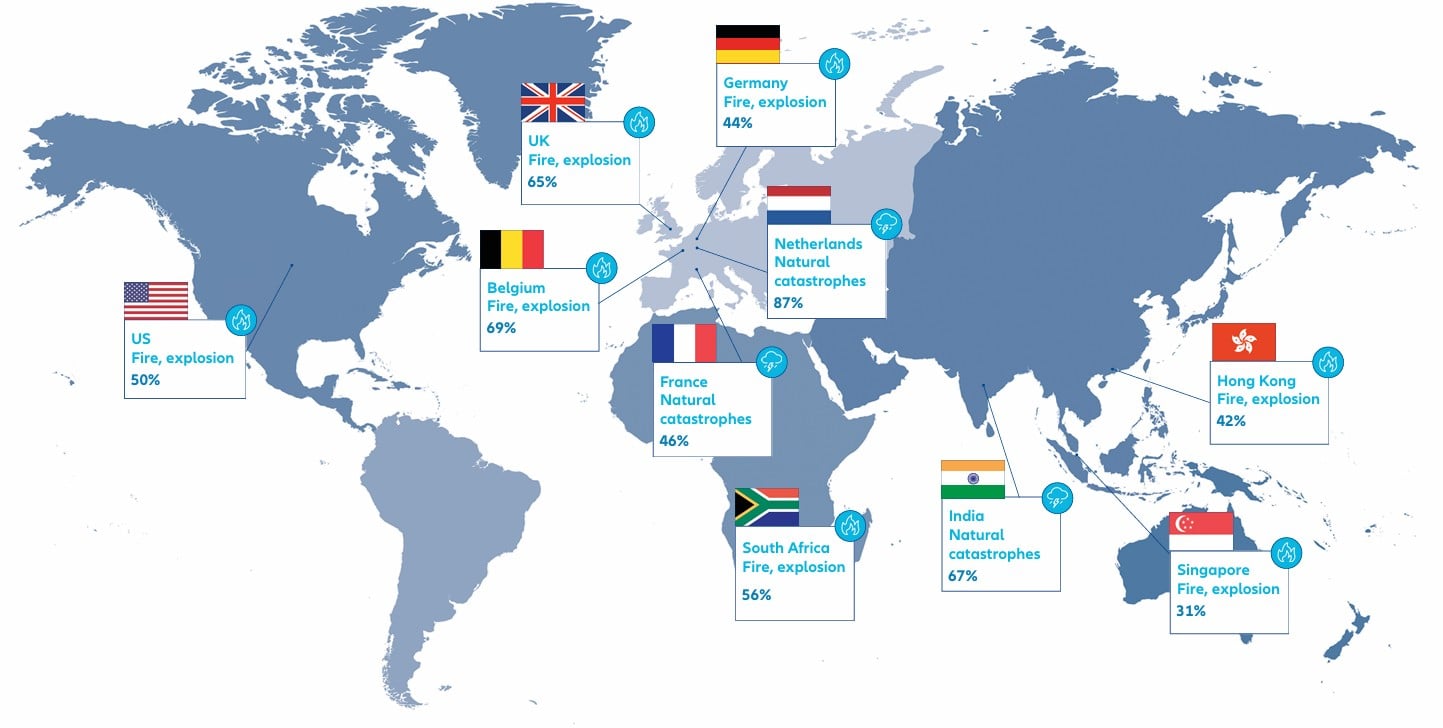
Source: Allianz Commercial
Based on analysis of 7,888 insurance industry claims with a total value of approximately €6.74bn (including the share of other insurers in addition to Allianz Commercial) between January 1, 2021 and December 31, 2025.
Other major drivers of business interruption insurance claims
Machinery breakdown ranks as the third major cause according to the value of all claims analyzed (6%) with water damage ranking fourth (3%). After natural catastrophe activity, water damage also ranks as the second most frequent cause of claims (25% of all claims analyzed), followed by fire and explosion (21%) and machinery breakdown (6%). Natural catastrophe activity, water damage and fire and explosion account for over 70% of the number of such claims analyzed.
Although natural catastrophe events such as hurricanes, storms, and floods often dominate the news headlines, it is non-natural catastrophe activity such as fires, water damage, and machinery breakdown that is the leading driver of business interruption claims by both frequency and severity. Non-natural catastrophe activity accounts for 66% of the value of business interruption insurance claims analyzed over the past five years and 74% of the number of claims.
Concentrated production and fragile supply chains
Concentrated production is amplifying business interruption vulnerabilities. Many industries still rely on a small number of specialist sites, suppliers or geographies for critical materials and components. When disruption strikes one of these nodes – whether through fire, cyber-attack or extreme weather – the impact can cascade globally.
The AI boom provides a compelling illustration. In the semiconductor sector, for example, strong demand and rising prices, together with the fact that alternative capacity is difficult to secure, means that even a relatively short disruption can translate into an outsized business interruption loss. The two costliest non-natural catastrophe events for business interruption insurance losses analyzed over the past five years involved fires at semiconductor manufacturing plants.
Geopolitics, tariffs and inflation influence the landscape
Geopolitical tensions – such as the war in Ukraine and conflict in the Middle East – continue to impact the economic environment in which losses develop. Through their impact on energy prices, logistics costs, supply chains and inflationary pressures, they can increase both the cost and complexity of recovery following a loss. Post Covid-19 pandemic inflation has already driven up business interruption costs in recent years, while tariffs are adding a further layer of complexity, particularly in sectors such as metals, manufacturing and technology, which depend on imported raw materials, components or equipment.
Tariffs can significantly increase the cost of recovery following a loss. When businesses are forced to secure materials, equipment or production capacity from overseas sources, higher import costs can materially increase mitigation expenses, highlighting how external economic factors can magnify business interruption exposures, even where the underlying loss event itself remains unchanged.
Cyber: a growing driver of business interruption
Although it currently doesn’t appear as one of the top causes of business interruption insurance losses by either severity or frequency of claims, cyber risk has emerged as a significant loss driver as ransomware attacks, cloud outages and software glitches disrupt businesses and ripple through supply chains.
Cyber incidents has been voted as the number one global risk in the Allianz Risk Barometer for the past five years in a row. Ransomware remains the top cause of cyber-related business interruption, but the report also highlights a significant shift in recent years. So-called non-attack disruptions, such as IT outages, flawed software updates and cloud service failures, driven by third party digital dependencies, can now represent a meaningful share of large cyber losses, challenging traditional assumptions that business interruption is almost always ransom-driven. Over 48,000 outages were tracked across hundreds of cloud and software services in 2025 alone. A ransomware attack on logistics provider Blue Yonder in November 2024 disrupted multiple UK retailers, while an attack on CDK, a US automotive software provider, caused a weeks-long outage for around 15,000 car dealerships at an estimated cost of US$1bn.
AI is a double-edged sword in the context of cyber risk. It is increasing the speed, scale and sophistication of cyber-attacks, pushing incidents more quickly into business interruption territory. At the same time, AI can also help to reduce business interruption losses with faster detection and response and business continuity insights, resulting in materially shorter interruption periods and lower business interruption losses.
Loss prevention and preparedness: the way forward
In today’s interconnected environment, the severity of a business interruption loss is not always determined by the extent of physical damage. It also underlines the need for robust business continuity planning, including the identification of critical production units, key dependencies and contingency arrangements to limit the impact of a localized disruption. More companies are now requesting risk surveys of key third-party suppliers – a practice well established in the automotive sector but increasingly adopted elsewhere.
For cyber-related business interruption, early detection and rapid response are the most effective loss reduction levers. Companies that detected and isolated cyber incidents early, prioritized revenue-critical systems and accepted temporary operating modes were able to shorten their effective business interruption period by days or even weeks. Tabletop exercises – essentially “fire drills” for cyber incidents – have also proven highly effective.
However, the report cautions that while many companies have invested in supply chain transparency and dual sourcing since the Covid-19 pandemic, tangible risk improvements – such as enhanced fire protection or increased inventory buffers – have been limited and not consistently applied across companies, sectors and countries. The report emphasizes that even modest investments in fire protection and natural catastrophe prevention for critical assets can significantly reduce business interruption exposure.
Photo: Adobe Stock, Wikimedia
Our experts
Allianz Commercial's Risk Consulting experts around the world provided their insights and knowledge to this report.